SuperTutor
$15/per page/Negotiable
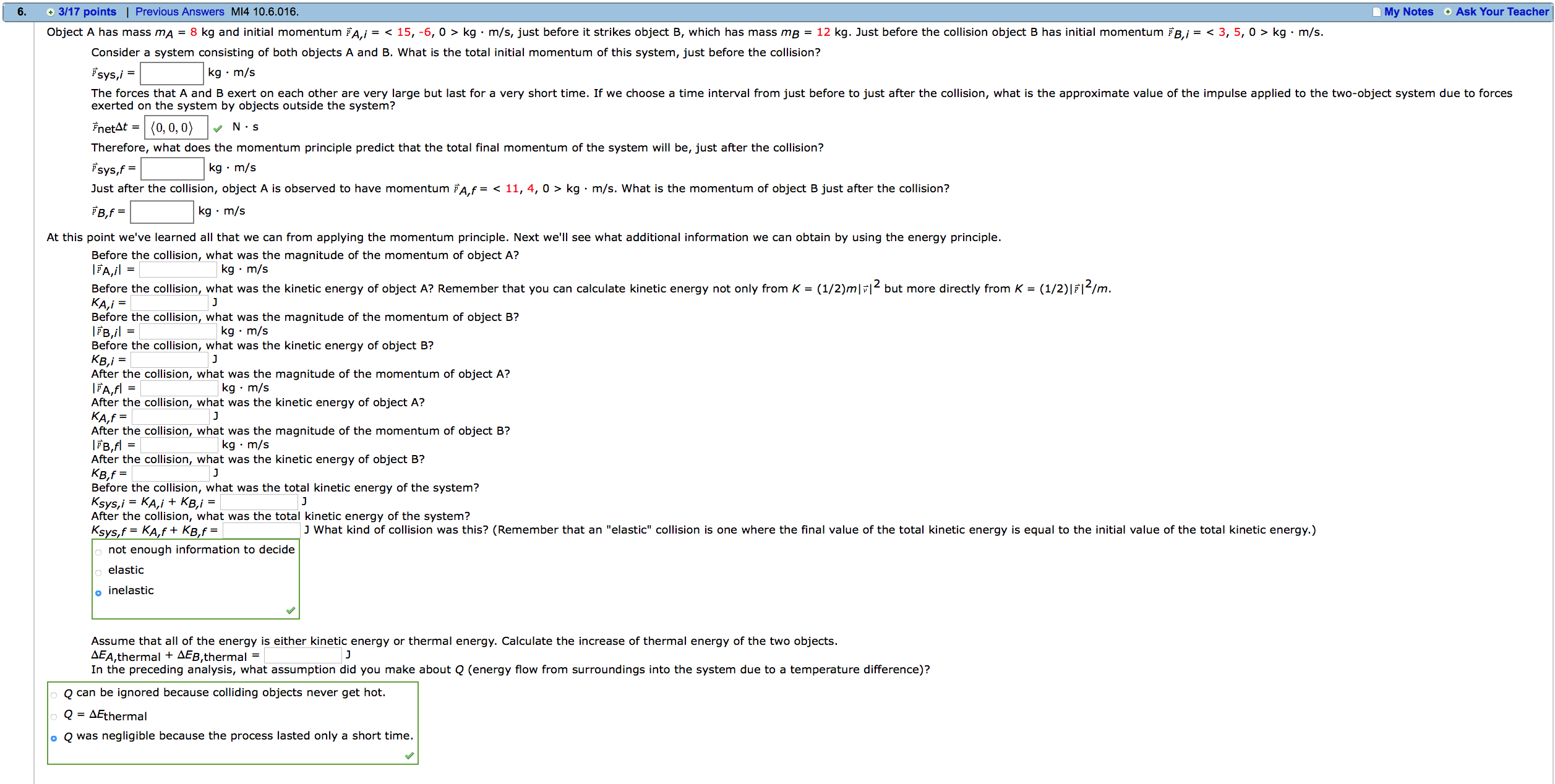
object A has mass mA — kg and iai momentum $4,! — < 15, -6, o > kg - m/s, just before it strikes object B, which has mass m5 — 12 kg. Just before the col n object B has I momentum $5,; — < 3, 5, o > kg ~ m/s,
Conslder a system consisting of both objects A and B. What Is the total lnltlal momentum of thls system, just before the colllslon?
Fsst = k9 ~ "1/5 The forces that A and B exert on each other are very large but last for a very short time. If we choose a time Interval from just before to just after the collision, what Is the approximate value of the Impulse applied to the two-object system due to forces
exerted on the system by objects outside the system? inetAt = (0,0,0) a N ~ 5
Therefore, what does the momentum principle predict that the total final momentum of the system will be, just after the collision? 35,”: kg - m/s
Just after the collision, object A is observed to have momentum FAlf= < 11, 4, o > kg - m/s. what is the momentum of object is just aner the collision? r‘B,f= kg - m/s At this point we've learned all that we can from applying the momentum principle. Next we‘ll see what additional information we can obtain by using the energy principle. Before the coliision,what was the magnitude of the momentum of object A?
lFA,il 109- m/s Before the collision, what was the kinetic energy of object A? Remember that you can calculate kinetic energy not only from K = (1/2)m|:|2 but more directly from K = (1/2)|r|2/m.
KAI] = J
Before the collision, what was the magnitude of the momentum of object B?
IFBJI kg- m/s Before the collision, w at was the kinetic energy of object B? K5,, = J
After the collision, what was the magnitude of the momentum of object A? Iii/ml = kg - m/s After the collision, what was the kinetic energy of object A? KA,f= 1 After the collision, what was the magnitude of the momentum of object 3?
IFBfl = k9 , Nils After the collision, what was the kinetic energy of object B? Kglf = J Before tihe collision, whatgwasthetotai kinetic energy of the system?
Ksys.i = '94,! + K5,; = J After the collision, what was the total kinetic energy of the system?
KS E” = KAI“ K5,; = u what kind of collision was this? (Remember that an “elast not enough information to decide
elastic ' collision is one where the final value of the total kinetic energy is equal to the initial value of the total kinetic energy) . inelastic oi Assume that all of the energy is either kinetic energy or thermal energy Calculate the increase of thermal energy of the two objedsr AEA,thermal + AEls,therrnal = J
In the preceding analysis, what assumption did you make about Q (energy flow from surroundings into the system due to a temperature difference)? »» Q can be ignored because colliding objects never get hot. i Q = AEthermal
. Q was negligible because the process lasted only a short time.
¥