SuperTutor
$15/per page/Negotiable
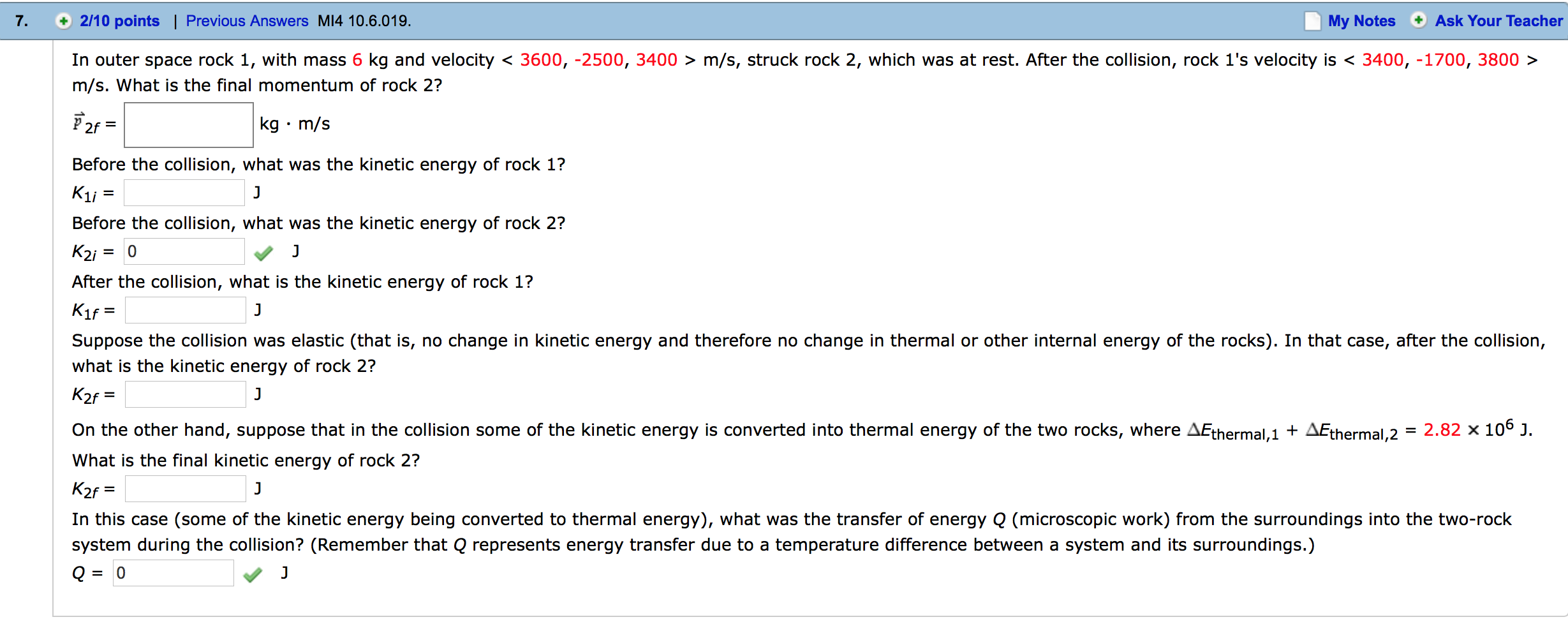
In outer space rock 1, with mass 6 kg and velocity < 3600, -2500, 3400 > m/s, struck rock 2, which was at rest. After the collision, rock 1's velocity is < 3400, -1700, 3800 >
m/s. What is the final momentum of rock 2? 52;: kg - m/s Before the oollision, what was the kinetic energy of rock 1? K1; = l J Before the collision, what was the kinetic energy of rock 2?
K2,- = o l y J Afier the collision, what is the kinetic energy of rock 1?
Klf = J Suppose the collision was elastic (that is, no change in kinetic energy and therefore no change in thermal or other internal energy of the rocks). In that case, after the collision,
what is the kinetic energy of rock 2? Kzf = J On the other hand, suppose that in the collision some of the kinetic energy is converted into thermal energy of the two rocks, where AEthermal,1 + AEthermaI,2 = 2.82 x 10⁶ J.
What is the final kinetic energy of rock 2? K2f = J In this case (some of the kinetic energy being converted to thermal energy), what was the transfer of energy Q (microscopic work) from the surroundings into the two-rock
system during the collision? (Remember that Q represents energy transfer due to a temperature difference between a system and its surroundings.) Q=l0 ‘IJ