SuperTutor
$15/per page/Negotiable
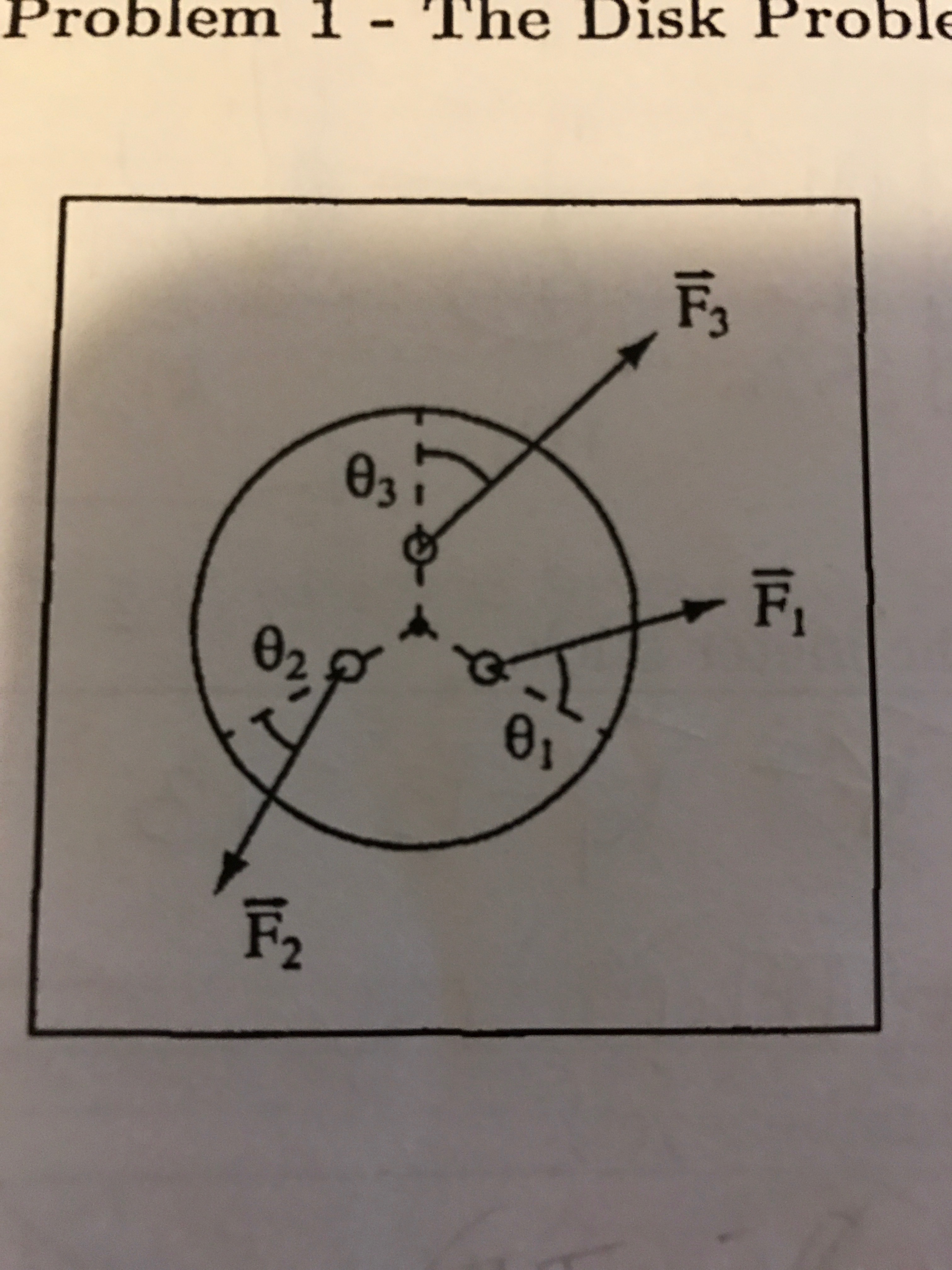
Consider the disk shown in the figure to the left. It is free to rotate about its center. The disk has three pegs situated as an equilateral triangle about the center; each peg is a distance r from the center of the disk. A different force is applied to each peg at an angle that is measured from the radial line that passes through the relevant peg. The disk is in rotational equilibrium (a = 0). The first force has a magnitude of F1 = 5N and is applied at an angle θ1 = 30 degrees. The second force has a magnitude of F2 = 6N and is applied at an angle θ2 = 25 degrees. The third force is applied at an angle θ3 = 40 degrees. What is the magnitude of F3?