SuperTutor
$15/per page/Negotiable
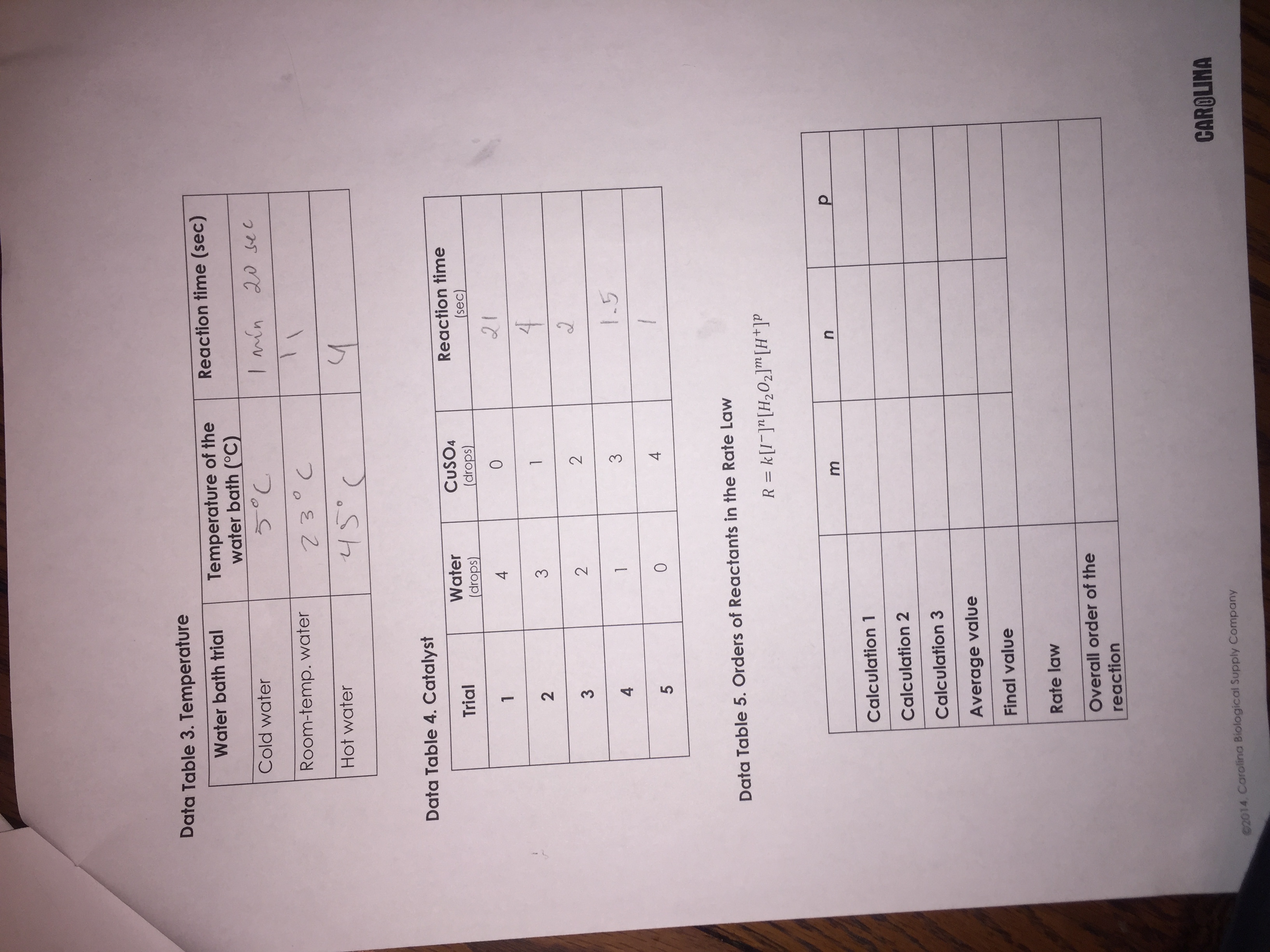
Factors Affecting Reaction Rates Carolina Distance Learning Investigation Manual ©2014, Carolina Biological Supply Company 2 Table of Contents Overview...................................................................................................................... 3 Objectives.................................................................................................................... 3 Time Requirements..................................................................................................... 3 Background................................................................................................................. 4 Materials....................................................................................................................... 9 Safety ......................................................................................................................... 10 Preparation................................................................................................................ 10 Activity 1: Calibration............................................................................................... 10 Activity 2: Concentration ........................................................................................ 12 Activity 3: Temperature............................................................................................ 14 Activity 4: Catalyst.................................................................................................... 15 Disposal and Cleanup ............................................................................................. 15 Activity 5: Determining the Rate Law .................................................................... 16 Data Tables ............................................................................................................... 17 ©2014, Carolina Biological Supply Company 3 Overview In this activity, the factors affecting the rate of an iodine-clock reaction will be investigated. In this reaction, two colorless solutions are combined and the reaction is completed when the solution turns a dark-blue color. The reaction rate will be studied by testing the effects of temperature, concentration, and addition of a catalyst on the rate. The measured data will be used to calculate the rate law for the iodine-clock reaction. Objectives • Explain the effect of concentration, temperature, and catalyst on reaction rate. • Determine the rate law expression from experimental data. • Describe chemical kinetics in terms of collision theory. Time Requirements Preparation........................................5 minutes Activity 1 ..........................................20 minutes Activity 2 ..........................................60 minutes Activity 3 ..........................................15 minutes Activity 4 ..........................................15 minutes Activity 5 ..........................................20 minutes The laboratory experiment may be stopped after the completion of any activity and resumed at a later time. If the experiment is interrupted before it is complete, ensure that all liquids are sealed to prevent evaporation and spillage. Clean the 24-well plate and test tubes and allow them to dry before resuming the next activity. ©2014, Carolina Biological Supply Company 4 Background The subject area of chemistry that examines the speeds or rates of reactions is called chemical kinetics. Chemical kinetics seeks to understand the factors that control reaction rates. The fundamental concept of chemical kinetics is collision theory. According to this theory, reactant molecules must collide with enough force to achieve activation energy before a reaction can occur. Activation energy is the minimum amount of energy required to break the chemical bonds of reactant molecules, after which they can form new products. Kinetic molecular theory indicates that molecules continuously collide; however, only those collisions that meet or exceed the required activation energy, and those that collide in a favorable orientation, will form new chemical bonds thus new products. The rate of chemical reactions can be influenced by temperature, reactant concentration, physical state of the reactants, and the presence of a catalyst. Temperature Kinetic molecular theory defines temperature as a measurement of the average kinetic energy of molecules. The Kelvin temperature scale begins with 0 K, the temperature at which there is no molecular motion. As temperature increases, the average kinetic energy of molecules also increases, which increases their average speed. At higher speeds, molecules collide more frequently and with higher energy, leading to faster reaction rates. Chemical reactions have faster reaction rates at higher temperatures. Concentration Concentration is the quantity of molecules per volume. As an example for liquid solutions, 1 Molar hydrochloric acid (1 M HCl) contains 1 mole of HCl molecules per liter of solution, whereas 2 M HCl contains 2 moles of HCl molecules per liter of solution. The concentration of gas molecules in a closed system is increased by adding more gas per volume, which increases the pressure, or by decreasing the volume of the gas. As molecular concentration of the reactants increases, the frequency of collisions increases, which leads to faster reaction rates. Most chemical reactions have faster reaction rates at higher concentrations. Physical State The physical state of the reactants is important for a reaction to occur. Two solids will have minimal surface area touching one another and hence, very little interaction between the molecules of the two solids. The reaction will usually be very slow. If a solid is added to a solution, a reaction may occur at the surface of the solid. However, if the solid is broken up into smaller pieces, the surface area increases and the rate of reaction will also increase. Reaction rates are affected by surface area because the greater the surface area, the greater the number of molecular collisions. Molecules must collide with each other for a reaction to occur; therefore, the greater the contact surface area, the greater the probability for molecular collisions. Chemical reactions between molecules in different phases (e.g., gas-solid or liquid-solid) have slow rates because collisions are limited. By contrast, reactions between molecules in a homogeneous solution have greater probability for molecular interactions and collisions, and have faster reaction rates. ©2014, Carolina Biological Supply Company 5 Catalyst A catalyst is a substance that increases the rate of a chemical reaction but is not chemically changed during the reaction. A catalyst provides a mechanism that makes it easier for bonds to break and reform into products. The catalyst lowers the reaction activation energy and greatly accelerates the reaction. For example, the decomposition of H2O2 in an aqueous solution to O2 and H2O is greatly accelerated by the addition of a catalyst. A bottle of 3% hydrogen peroxide will last for years before it completely decomposes to water and oxygen. If a drop of potassium iodide (a catalyst for this reaction) is added to the solution, it will start to react and within minutes the reaction will be complete. Enzymes are nature’s catalysts and speed up any crucial biochemical reactions in most organisms. Rate Laws To properly study the rate of a reaction, a rate law must be written. Many reactions occur in multiple steps and the overall rate of the reaction will depend on the step that takes the longest amount of time. This step is called the rate determining step. The rate law for a reaction can only be determined experimentally and provides understanding of the reaction mechanism. The rate of a chemical reaction, also called reaction rate (R) is how long it takes for the reaction to occur. It is defined as the concentration change of reactants that occurs during a specified time period. The rate law for a chemical reaction is a mathematical relationship between reaction rate and the concentration of each reactant. Determining the rate law for a chemical reaction can be best explained with the following example and steps. Step 1: Write the chemical equation: A + B → Products Step 2: The reaction rate is written as being proportional to the starting concentration of each reactant. Brackets ([A] and [B]) represent the starting molar concentrations of each reactant in moles/L or M. However, each reactant may influence the reaction rate differently. Reaction orders are used to indicate the importance of a reactant to the rate determining step and are represented by the exponents n and m. If the exponent for reactant A is 1, then the reaction is said to be first-order for A. If the exponent is 2, then the reaction is said to be second-order for A. For most reactions, the exponent is 0, 1, or 2. The exponent value must be determined experimentally because it is the extent to which the concentration of a species affects the rate of a reaction. The reaction order cannot be determined from the chemical equation. The proportional rate law is written using the reaction rate, the concentration of each reactant, and the reaction order for each reactant: R ∝ [A]n[B]m ©2014, Carolina Biological Supply Company 6 Step 3: To write the final rate law, the reaction must be run multiple times. The concentration of each reactant is changed in an orderly approach to determine the impact the rate of that reactant has on the reaction rate. Once the order of reaction for each reactant is determined experimentally, the rate equation is solved by inserting the reaction rate constant (k). R = k[A]n[B]m The units for reaction rates are usually expressed as molarity per second (M/s) or the change of concentration over time. The best method to determine the exponents or the reaction order is to vary the concentration of one of the reactants while keeping all other reactant concentrations and reaction conditions constant. For example, examine the following data table for the reaction A + B → Products. In each trial, the starting concentration of one reactant is changed while the other reactant concentration is held constant, and the reaction time is measured and recorded. Trial [A] [B] Time (T, sec) Rate (R) = 1/T (M/s) 1 0.10 M 0.10 M 25.0 0.04 2 0.20 M 0.10 M 12.5 0.08 3 0.10 M 0.20 M 6.25 0.16 The results from Trials 1 and 2 show that the reaction rate doubles (from 0.04 to 0.08 M/s) as the concentration of A doubles (from 0.10 to 0.20 M). Consider what the exponent n would have to equal for [A] to satisfy this condition. [A]n = R [2]n = 2 The exponent n would have to equal 1, indicating that the reaction is first-order for A. Now consider Trials 1 and 3, which show that the reaction rate increases by a factor of four (from 0.04 to 0.16 M/s) as the concentration of B doubles (from 0.10 to 0.20 M). Consider what the exponent m would have to equal for [B] to satisfy this condition. [B]m = R [2]m = 4 The exponent m would equal 2, indicating that the reaction is second-order for B. If the answer is not easy to determine by simple inspection of the data, the following equation can be used to determine an unknown exponent: � [?2] [?2] � ? = ????2 ????1 Using the values given in the preceding data table, solve the equation for n and m, and confirm that the same values are obtained. ©2014, Carolina Biological Supply Company 7 To solve for the exponent (reaction order) of [A], � 0.20 ? 0.10 ?� ? = 0.08 ?/? 0.04 ?/? 2? = 2 ln 2? = ln 2 ?(ln 2) = ln 2 ? = 1 To solve for the exponent (reaction order) of [B], � 0.20 ? 0.10 ?� ? = 0.16 ?/? 0.04 ?/? 2? = 4 ln 2? = ln 4 ?(ln 2) = ln 4 ? = ln 4 ln 2 ? = 2 When solving for an unknown reaction order, the only reaction variable that can be allowed to change is the concentration of the reactant for which the order is being determined. The concentrations of all other reactant species must remain the same. Furthermore, the reaction temperature and the physical state of the reactants must be held constant for all trials. The rate-law expression can be written once the numerical values of the reaction order exponents (n and m) are known. ? = ?[?]?[?]? ? = ?[?] 1[?]2 In our example, the reaction order with respect to [A] is 1, and the reaction order with respect to [B] is 2. The overall order of the reaction is the sum of the order for each reactant, which in this example is 1 + 2 = 3. ©2014, Carolina Biological Supply Company 8 Once the reaction orders have been experimentally determined, the rate constant k can be determined by using data from any of the trials. For example, using the data from Trials 1 and 3 gives the same rate constant. Trial 1 R = k[A][B]2 k = R / [A][B]2 k = (0.04 M/s) / [0.10 M][0.10 M]2 k = (0.040 M/s) / [0.10 M][0.01 M2] k = (0.040 M/s) / [0.001 M3] k = 40 M–2s–1 Trial 3 R = k[A][B]2 k = R / [A][B]2 k = (0.160 M/s) / [0.10 M][0.20 M]2 k = (0.160 M/s) / [0.10 M][0.04 M2] k = (0.160 M/s) / [0.004 M3] k = 40 M–2s–1 Iodine Clock Reaction The iodine clock reaction performed in this laboratory investigation occurs in the following three steps: Step 1: 3I – (aq) + H2O2 (aq) + 2H+ (aq) → I3 – (aq) + 2H2O (l) Step 2: I3 – (aq) + 2S2O3 2– (aq) → 3I – (aq) + S4O6 2– (aq) Step 3: 2I3 – (aq) + starch → starch– I5 – complex + I – (aq) In reaction step 1, iodide ions are oxidized by hydrogen peroxide ions in an acidic solution to form triiodide ions. In step 2, the triiodide ions are reduced by thiosulfate (S2O32–) to form iodide ions. This reaction occurs quickly, and triiodide ions are consumed by thiosulfate as quickly as they are formed. Reaction 3 only occurs when all thiosulfate is consumed. After all the thiosulfate is consumed, triiodide ions are now available to react with starch to form a pentaiodide–starch complex that is a dark blue. The appearance of a dark blue-black color signals the end of the three reactions. The reaction begins when the reactants are mixed together, and ends when the dark blueblack color is observed. ©2014, Carolina Biological Supply Company 9 Materials Included in the materials kit Potassium iodide solution, 0.05M, KI Hydrochloric acid solution, 0.1M, HCl Sodium thiosulfate solution, 0.01M, Na2S2O3 Starch solution, 1% 1-mL syringe 24-well plate Needed from the equipment kit: Polystyrene test tubes Test tube rack 10-mL graduated cylinder Thermometer Plastic pipets Plastic cups, 10-oz Plastic medicine cup Needed from the chemical kit: Hydrogen peroxide, 3%, H2O2 Copper(II) sulfate solution, CuSO4 Needed, but not supplied: Ice Warm water Pure water* Timing device or stop watch Reorder Information A replacement kit for Factors Affecting Reaction Rates Investigation, item number 580318, can be ordered from Carolina Biological Supply Company. Call 1-800-334-5551 to order. * Bottled or purified water should be used to remove most of the solids that are found in tap water. Filtered water from a home water purifier (e.g. Brita or PUR) works well. ©2014, Carolina Biological Supply Company 10 Safety Read all instructions for this laboratory activity before beginning. Follow the instructions closely and observe established laboratory safety practices, including use of appropriate personal protective equipment (PPE) described in the Introduction to Safety. Hydrochloric acid solution is corrosive to body tissue and is a skin irritant. It is also corrosive to eyes so wear safety goggles. If hydrochloric acid splashes on your skin or face, then flush area immediately with water. Hydrogen peroxide is a skin irritant. Copper(II) sulfate is toxic by ingestion, keep away from children and pets. Wear safety glasses while performing this laboratory investigation. Do not eat, drink, or chew gum while performing this activity. Wash your hands with soap and water before and after performing the activity. Clean up the work area with soap and water after completing the investigation. Keep pets and children away from lab materials and equipment. Preparation 1. Read through the Activity sections to familiarize yourself with all steps before you begin the experiment. 2. Obtain all required materials. 3. Clean and sanitize the work area. 4. Fill a plastic medicine cup with pure water. In this investigation, use a different pipet for each reagent. Wrap a piece of tape around the barrel of the pipet and write the reagent name on the tape. Use a different well in the well plate for each reaction. Do not cross-contaminate the contents of one well to another, and do not allow microdroplets of the solutions to splash into multiple wells during delivery. Use a different row of the plate for each activity. Start at the left well and proceed right. Solutions can be discarded after each activity. Before reusing the plate, rinse all wells several times with purified water and allow them to dry thoroughly. ©2014, Carolina Biological Supply Company 11 Activity 1: Calibration Tests 1. Orient the 24-well plate so that there are four wells across (horizontal axis) and six wells down (vertical axis). 2. In the top-left well, place 8 drops of KI. 3. Add 2 drops of HCl to the KI solution in the well. 4. Add 4 drops of starch to the KI solution in the well. 5. Add 8 drops of Na2S2O3 solution (sodium thiosulfate) to the KI solution in the well. 6. Mix the solution by gently swirling the 24-well plate in a small circle on the table. 7. With the syringe, draw up 0.4 mL of H2O2. 8. As the H2O2 is added to the solution in the well, begin timing. 9. Mix the solution by gentle swirling, and monitor the color. 10. Record the amount of time it takes for the entire solution to turn a dark blue or black color in Data Table 1. 11. If the solution took 18−22 seconds to turn dark blue, then no additional calibration trials are necessary. 12. If the reaction took more than 18−22 seconds, then the amount of sodium thiosulfate must be decreased. Repeat steps 1–10 in the next well in the row, but add 7 drops of Na2S2O3 instead of 8 drops. Continue the trials, reducing the Na2S2O3 by 1 drop for each trial, until it takes between 18−22 seconds for the dark-blue color to appear. 13. If the reaction took less than 18−22 seconds, then the amount of sodium thiosulfate must be increased. Repeat steps 1–10 in the next well in the row, but add 9 drops of Na2S2O3 instead of 8 drops. Continue the trials, adding 1 more drop of Na2S2O3 for each trial, until it takes between 18−22 seconds for the dark- blue color to appear. 14. Record the number of drops of Na2S2O3 used to achieve the approximately 20- second change in Data Table 1. This is the number of drops that will be used in all subsequent experiments. Add the hydrogen peroxide quickly but without splashing. ©2014, Carolina Biological Supply Company 12 Activity 2: Concentration Concentration of KI Perform steps 1−10 described in the calibration activity, but use the number of drops of each reactant that are specified in the following table. Use the number of drops of Na2S2O3 determined in Activity 1 for all trials. In this set of trials, only the amounts of KI and water are changed. The water is added to ensure that the final volume and the concentrations of all reactants are constant. Record the reaction times for these trials in Data Table 2. KI trial KI (drops) HCl (drops) Starch (drops) Water (drops) Na2S2O3 (drops) H2O2 (mL) 1 8 2 4 0 Activity 1 0.4 2 8 2 4 0 Activity 1 0.4 3 6 2 4 2 Activity 1 0.4 4 6 2 4 2 Activity 1 0.4 5 4 2 4 4 Activity 1 0.4 6 4 2 4 4 Activity 1 0.4 7 2 2 4 6 Activity 1 0.4 8 2 2 4 6 Activity 1 0.4 H2O2 Concentration Effects These trials will follow the same procedure as specified above, but this set of trials will vary the concentration of H2O2. As stated above, the amount of water added to each reaction must be adjusted so that the final volume and the concentrations of all reactants are constant. To avoid contamination, it may be best to rinse out the syringe and add the required amount of water to all wells before starting any trials. Record the reaction times in Data Table 2a. H2O2 trial KI (drops) HCl (drops) Starch (drops) Water (mL) Na2S2O3 (drops) H2O2 (mL) 1 8 2 4 0.0 Activity 1 0.4 2 8 2 4 0.0 Activity 1 0.4 3 8 2 4 0.1 Activity 1 0.3 4 8 2 4 0.1 Activity 1 0.3 5 8 2 4 0.2 Activity 1 0.2 6 8 2 4 0.2 Activity 1 0.2 7 8 2 4 0.3 Activity 1 0.1 8 8 2 4 0.3 Activity 1 0.1 ©2014, Carolina Biological Supply Company 13 Concentration of HCl 1. This trial follows the same procedure as specified for determining the concentration of KI (see the following table), but it varies the concentration of HCl. 2. To vary the HCl concentration, a series of new HCl concentrations will be prepared from the stock 0.1 M HCl reagent (the 0.1 M HCl stock reagent is the 100% HCl solution). The same volume of HCl will be used in each trial (2 drops), but the HCl concentration contained in this volume will change. Record the reaction times in Data Table 2b. 3. In the first well of a row, add 15 drops of 0.1 M HCl and 5 drops of pure water. Swirl to mix. This is the 75% HCl solution. 4. In the second well of the row, add 10 drops of HCl and 10 drops of pure water. Swirl to mix. This is the 50% HCl solution. 5. In the third well of the row, add 5 drops of HCl and 15 drops of pure water. Swirl to mix. This is the 25% HCl solution. HCl trial KI (drops) % HCl (2 drops) Starch (drops) Water (drops) Na2S2O3 (drops) H2O2 (mL) 1 8 100% 4 0 Activity 1 0.4 2 8 100% 4 0 Activity 1 0.4 3 8 75% 4 0 Activity 1 0.4 4 8 75% 4 0 Activity 1 0.4 5 8 50% 4 0 Activity 1 0.4 6 8 50% 4 0 Activity 1 0.4 7 8 25% 4 0 Activity 1 0.4 8 8 25% 4 0 Activity 1 0.4 ©2014, Carolina Biological Supply Company 14 Activity 3: Temperature 1. Place one test tube into each of the three plastic cups and allow the tube to lean against the edge. Mark the cups with a horizontal line at the halfway points of the test tubes, and remove the test tubes from the cups. 2. Prepare three water baths as follows: a. For a room-temperature water bath, add room-temperature water to one cup until the water reaches the mark. Room temperature is approximately 25°C. If the water temperature varies greatly from this temperature, add a small amount of warm or cool water until it reaches this temperature. Record the temperature in Data Table 3. b. For a cold-water bath, add ice to a cup until the ice is approximately halfway to the mark and then add water until the level reaches the mark. The cold-water bath should be approximately 5°C, or approximately 20°C below that of the room-temperature bath. Immediately before using the cold-water bath, record its temperature in Data Table 3. c. For a hot-water bath, add hot tap water to a cup until the water level reaches the mark. Ensure that the temperature of this water is approximately 45°C, or approximately 20°C above that of the room-temperature bath. Immediately before using the hot-water bath, record its temperature in Data Table 3. 3. In this activity, the KI, HCl, starch, and Na2S2O3 solutions will be added to one test tube and placed in the appropriate water bath for 5 minutes. The amounts of each reactant are the same as those used in the first trial in Activity 2 (concentration of KI). 4. Add 0.4 mL H2O2 to a clean test tube, and place this tube in the appropriate water bath for 5 minutes. This serves to pre-equilibrate the H2O2 solution to the required temperature before adding it to the reaction. 5. After preparing the reaction solutions (step 3 of this activity), gently swirl the solution so the reactants are mixed and the solution reaches the temperature of its water bath. 6. When the reactants have reached the temperature of the water bath, add the preequilibrated H2O2 to the reaction test tube and begin timing. The reaction test tube should be kept in the water bath. 7. Swirl the solution and monitor the color. 8. Record the amount of time it takes for the room-temperature reactants to turn blueblack in Data Table 3. 9. Repeat the mixing and reaction processes with the pairs of tubes in both the hotwater and cold-water baths. Record the time it takes for the reactions to reach a blue-black color in Data Table 3. Activity 4: Catalyst ©2014, Carolina Biological Supply Company 15 1. Add one drop of 0.5M copper (II) sulfate solution to one of the wells. 2. Add about 3 mL of pure water to the well to dilute the copper sulfate. Swirl the solution to mix. 3. Repeat the reaction with the following reactant quantities. Use the dilute copper sulfate solution that was just prepared. 4. Record the time in Data Table 4. HCl trial KI (drops) HCl (drops) Starch (drops) Water (drops) CuSO4 (drops) Na2S2O3 (drops) H2O2 (mL) 1 8 2 4 4 0 Activity 1 0.4 2 8 2 4 3 1 Activity 1 0.4 3 8 2 4 2 2 Activity 1 0.4 4 8 2 4 1 3 Activity 1 0.4 5 8 2 4 0 4 Activity 1 0.4 Disposal and Cleanup 1. Dispose of reaction solutions in the sink, and then rinse the sink well. 2. Clean and dry all equipment and return it to the equipment kit. 3. Clean and sanitize the work space. ©2014, Carolina Biological Supply Company 16 Activity 5: Determining the Rate Law 1. The rate law is determined by observing the effect of different concentrations of KI, H2O2, and HCl on the rate of the reaction (Activity 2). The exponents (reaction order) of each reactant are determined by evaluating the change in reaction rate when only that reactant concentration is changed. The overall chemical reaction is written as follows: 3I‾ (aq) + H2O2 (aq) + 2H+ (aq) → I3‾ (aq) + 2H2O (l) 2. The rate law in terms of the reactants is given by ? = ?[?−]?[?2?2]?[?+]? 3. Determine the reaction order for each reactant using the following table. a. For each set of duplicate reactant concentration trials, calculate the average reaction rate for that reactant concentration. b. If the reaction time does not change with increasing reactant concentrations, then the reaction does not depend on that reactant concentration, and the exponent (reaction order) is zero (0). c. If the reaction time changes proportionately with reactant concentration change, then the exponent (reaction order) is one (1). d. If the reaction time changes exponentially, then the exponent (reaction order) is two (2). Reactant Concentration change Reaction time change Concentration reaction time Reaction order I − 0.75 I − 0.50 I − 0.25 H2O2 0.75 H2O2 0.50 H2O2 0.25 HCl 0.75 HCl 0.50 HCl 0.25 4. Perform the calculations and record the results in Data Table 5. ©2014, Carolina Biological Supply Company 17 Data Tables Data Table 1. Calibration Trial Na2S2O3 (Drops) Reaction time (sec) 1 2 3 How many drops of Na2S2O3 will be used in the remaining experiments?_________ Data Table 2. Effects of KI Concentration Trial KI (drops) HCl (drops) Starch (drops) H2O (drops) Na2S2O3 (drops) H2O2 (mL) Time1 (sec) Time2 (sec) Average time (Tavg) (sec) Rate (1/Tavg) 1 8 2 4 0 0.4 2 8 2 4 0 0.4 3 6 2 4 2 0.4 4 6 2 4 2 0.4 5 4 2 4 4 0.4 6 4 2 4 4 0.4 7 2 2 4 6 0.4 8 2 2 4 6 0.4 ©2014, Carolina Biological Supply Company 18 Data Table 2a. Effects of H2O2 Concentration Trial KI (drops) HCl (drops) Starch (drops) H2O (mL) Na2S2O3 (drops) H2O2 (mL) Time1 (sec) Time2 (sec) Average time (Tavg) (sec) Rate (1/Tavg) 1 8 2 4 0 0.4 2 8 2 4 0 0.4 3 8 2 4 0.1 0.3 4 8 2 4 0.1 0.3 5 8 2 4 0.2 0.2 6 8 2 4 0.2 0.2 7 8 2 4 0.3 0.1 8 8 2 4 0.3 0.1 Data Table 2b. Effects of H+ Concentration Trial KI (drops) HCl (%) Starch (drops) H2O (drops) Na2S2O3 (drops) H2O2 (mL) Time1 (sec) Time2 (sec) Average time (Tavg) (sec) Rate (1/Tavg) 1 8 100% 4 0 0.4 2 8 100% 4 0 0.4 3 8 75% 4 0 0.4 4 8 75% 4 0 0.4 5 8 50% 4 0 0.4 6 8 50% 4 0 0.4 7 8 25% 4 0 0.4 8 8 25% 4 0 0.4 ©2014, Carolina Biological Supply Company 19 Data Table 3. Temperature Water bath trial Temperature of the water bath (°C) Reaction time (sec) Cold water Room-temp. water Hot water Data Table 4. Catalyst Trial Water (drops) CuSO4 (drops) Reaction time (sec) 1 4 0 2 3 1 3 2 2 4 1 3 5 0 4 Data Table 5. Orders of Reactants in the Rate Law ? = ?[?−]?[?2?2]?[?+]? m n p Calculation 1 Calculation 2 Calculation 3 Average value Final value Rate law Overall order of the reaction
Attachments: