Stability from Late Adolescence to Early Adulthood
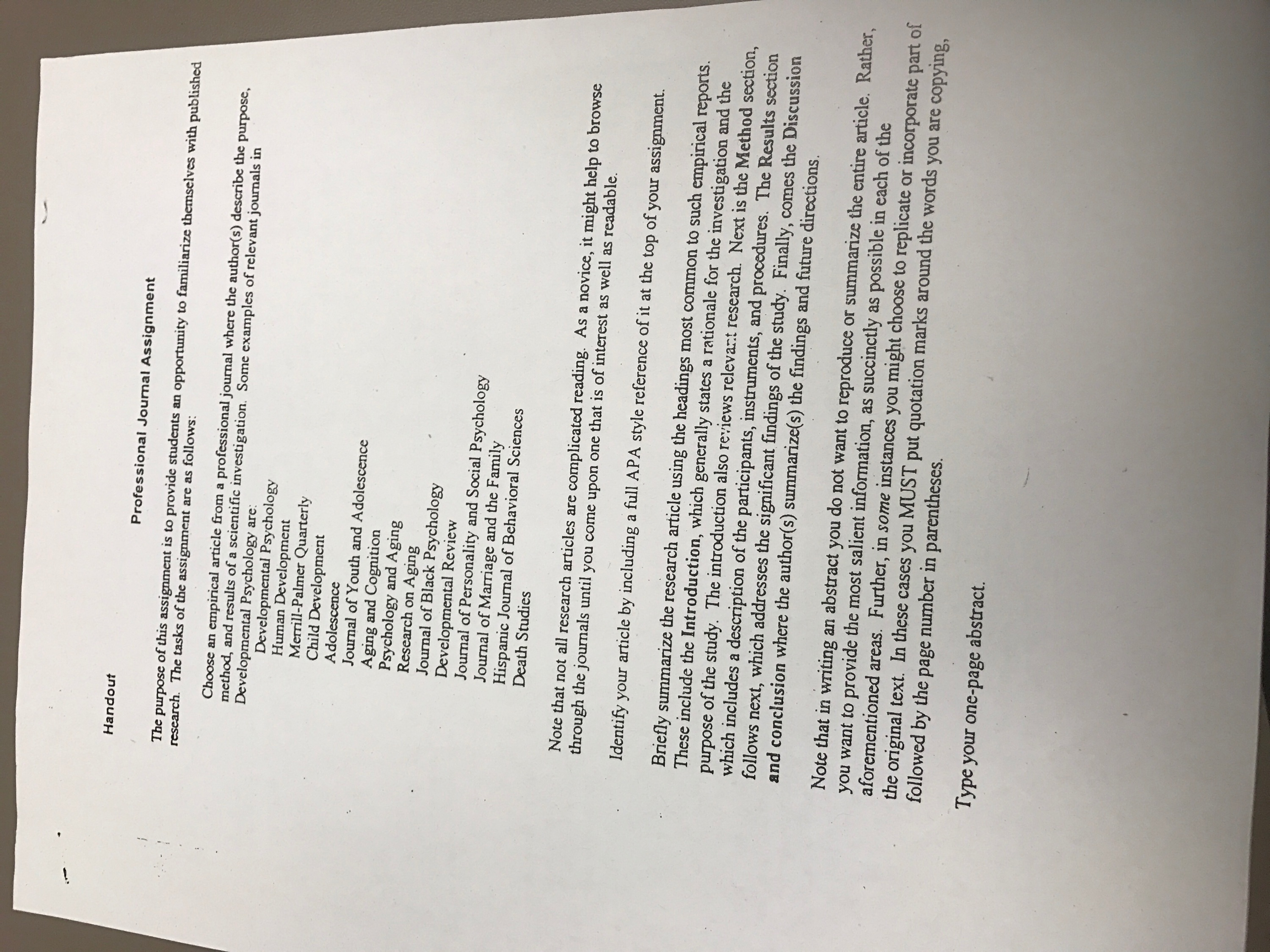
please do my home work assignment ? its due tuesday morning NOVEMBER 28TH
ORIGINAL ARTICLE High and Low Cognitive Risk for Depression: Stability from Late Adolescence to Early Adulthood Sarah E. Romens Æ Lyn Y. Abramson Æ Lauren B. Alloy Published online: 20 November 2008 Ó Springer Science+Business Media, LLC 2008 Abstract Negative cognitive styles are an important cognitive vulnerability for depression, but stability of high cognitive risk, once developed, is unclear. The current study examined stability of cognitive vulnera- bility to depression in individuals at high and low cognitive risk (extreme scores on both the CSQ and DAS) over a 7-year period from late adolescence through early adulthood. Cognitive vulnerability showed high relative stability, as evidenced by the moderate to high correlation ( r s = 0.62) between cognitive risk status at study onset and at Fnal assess- ment 7 years later. Consistent with stability, subgroups were identiFed using growth mixture modeling, and most cognitively high-risk (62.22% for CSQ, 68.89% for DAS) and low-risk (55.05% for CSQ, 57.96% for DAS) participants showed stable trajectories of cogni- tive vulnerability. Despite this overall pattern of stability, small mean group changes were found, and a minority of participants showed changing trajectories, consistent with regression toward the mean. Predictors of change and implications for risk for depression in high- and low-risk individuals are discussed. Keywords Cognitive vulnerability Á Depression Á Trajectory Á Stability Once an individual develops vulnerability to depres- sion, can it change without intervention? According to cognitive theories of depression (Abramson et al. 1989 ; Beck 1967 ), some individuals have a charac- teristic way of negatively interpreting life events that provides risk for depression, and this vulnerability appears to coalesce and become fully operational during adolescence (Gibb and Alloy 2006 ; Hankin and Abramson 2001 ; Hyde et al. 2008 ). The current study examines stability of cognitive vulnerability to depression in individuals at high and low cognitive risk during the transition from late adolescence, when this vulnerability already has developed, to early adulthood, a critical developmental period (Arnett 2000 ). Cognitive Theories of Depression Hopelessness theory (Abramson et al. 1989 ); Beck’s ( 1967 ) theory of depression are both vulnerability- stress models in which a cognitive pattern serves as a S. E. Romens ( & ) Á L. Y. Abramson Department of Psychology, University of Wisconsin–Madison, 184 W. J. Brogden Hall, 1202 W. Johnson St., Madison, WI 53706, USA e-mail: sebrehm@wisc.edu L. B. Alloy Department of Psychology, Temple University, Philadelphia, PA, USA 123 Cogn Ther Res (2009) 33:480–498 DOI 10.1007/s10608-008-9219-5

Answers

Status NEW
Posted 21 Oct 2017 12:10 PM
My Price 10.00
----------- ----------- H-----------ell-----------o S-----------ir/-----------Mad-----------am ----------- Th-----------ank----------- yo-----------u f-----------or -----------usi-----------ng -----------our----------- we-----------bsi-----------te -----------and----------- ac-----------qui-----------sit-----------ion----------- of----------- my----------- po-----------ste-----------d s-----------olu-----------tio-----------ns.----------- Pl-----------eas-----------e p-----------ing----------- me----------- on----------- ch-----------at -----------I a-----------m o-----------nli-----------ne -----------or -----------inb-----------ox -----------me -----------a m-----------ess-----------age-----------
Not Rated(0)