ComputerScienceExpert
$18/per page/
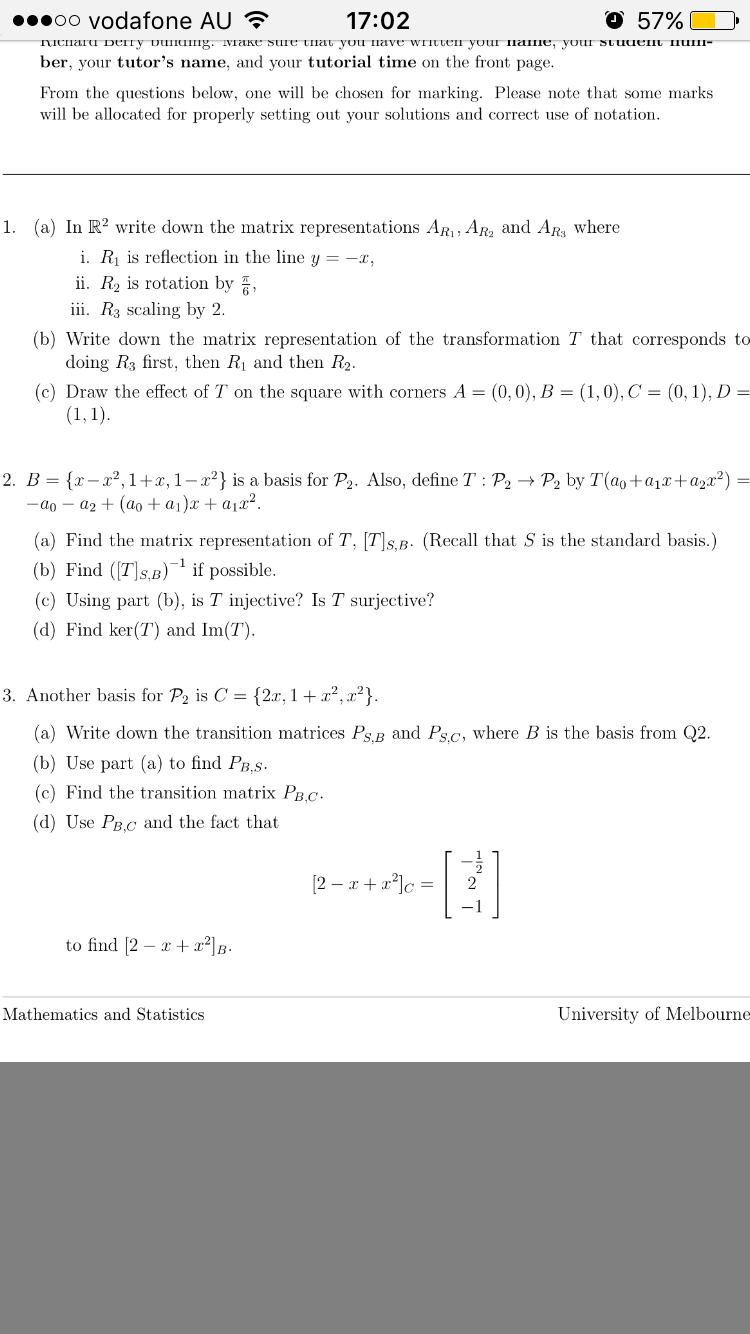
please see the picture. 1.
a)In R2 write down the matrix representations AR1 , AR2 and AR3 where i. R1 is reflection in the line y = −x,
ii. R2 is rotation by π , 6
iii. R3 scaling by 2.
b)Write down the matrix representation of the transformation T that corresponds to
doing R3 first, then R1 and then R2.
c)Draw the effect of T on the square with corners A = (0,0),B = (1,0),C = (0,1),D =
(1, 1).
2.
B={x−x2,1+x,1−x2}isabasisforP2. Also,defineT :P2 →P2 byT(a0+a1x+a2x2)=
−a0 −a2 +(a0 +a1)x+a1x2.
a)Find the matrix representation of T, [T]S,B. (Recall that S is the standard basis.)
b) Find ([T]S,B)−1 if possible.
c) Using part (b), is T injective? Is T surjective?
d) Find ker(T) and Im(T).
3
AnotherbasisforP2 isC={2x,1+x2,x2}.
* (a) Write down the transition matrices PS,B and PS,C, where B is the basis from Q2.
* (b) Use part (a) to find PB,S.
* c) Find the transition matrix PB,C. (d) Use PB,C and the fact that 。。
Attachments: