ComputerScienceExpert
$18/per page/
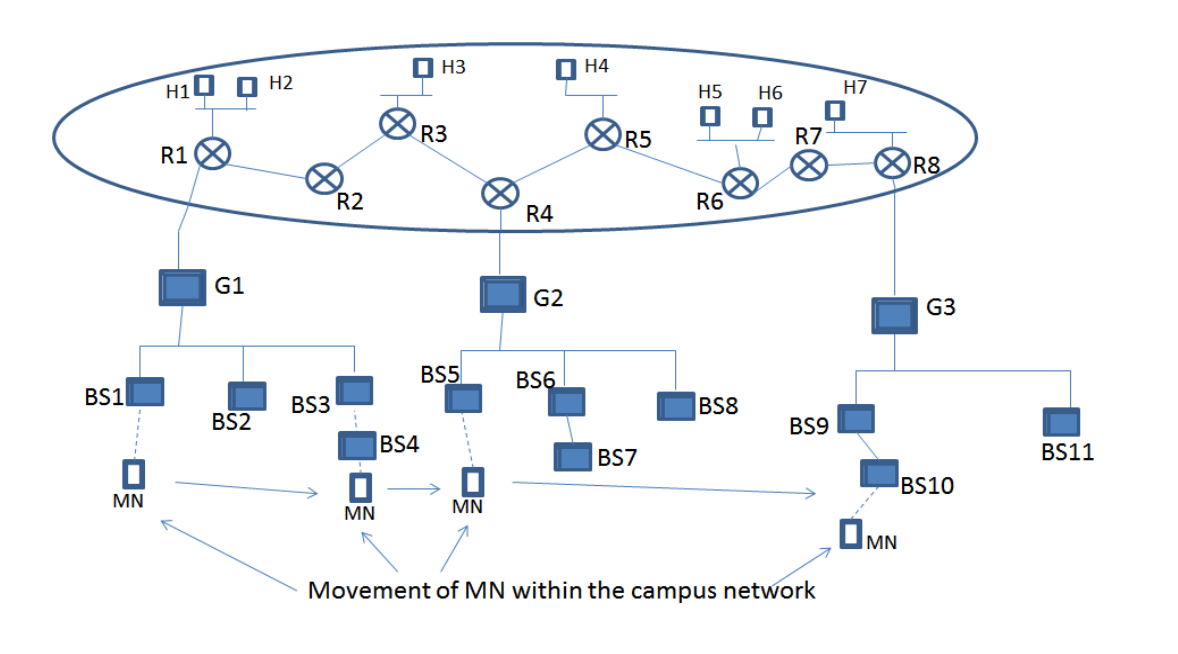
An organization has deployed a campus network using cellular IP. Thecellular IP network extends the wired infrastructure of the campus asshown in the figure below. The gateways in cellular IP connect theirrespective wireless segments to the wired segment. Each Basestation in the wireless segment provides layer 3 functionality (in otherwords, they act as IP forwarding engines). The campus networksupports multicast routing. All the components in the wireless partstrictly adhere to cellular IP standard. Assume that this campusnetwork deploys a source based multicast routing scheme – aprotocol that builds source based multicast distribution trees (Referto Appendix for a brief explanation on Source based multicastrouting).A visiting mobile node MN enters the wireless network and initiallygets registered to its home network via BS1-G1 and acquires a Careof Address (CoA - an address from the campus network addressspace). The CoA assigned to the MN remains unchanged irrespectiveof MN’s movements within the campus network. In other words, MNdoes not need to acquire a new CoA upon moving to a wirelesssegment under the same or under a different gateway.While initially at BS1, the MN joins a multicast group G whose scopeis local to this campus network (all sources, and members reside inthe campus network). Assume that hosts H1, H3, H5, and H7 aremembers of this group with H1 and H7 also acting as Multicastsources. Furthermore, assume that MN itself is a source for multicasttraffic. In this scenario, explain what problems can arise in multicastcommunication due to MN’s mobility.
Attachments: