SuperTutor
$15/per page/Negotiable
Part D (Light) (25 marks) (a) (b) (C) (d) A certain radar installation used to track airplanes transmits electromagnetic radiation
of wavelength 3 cm. (i) What is the frequency of this radiation, measured in billions of hertz (GHz)?
(3 marks) (ii) What is the time required for a pulse of radar waves to reach an airplane 5
kilometers away and return?
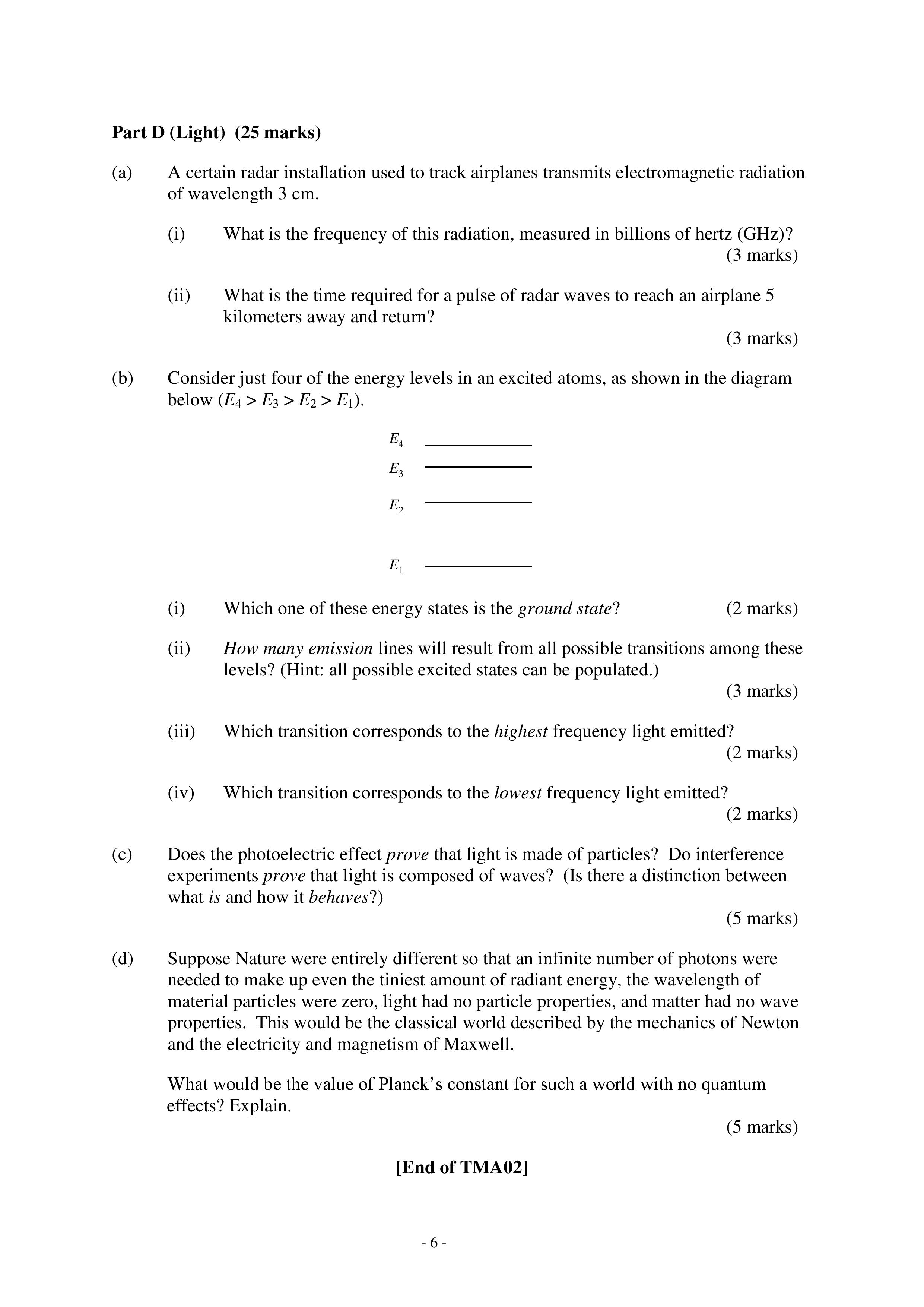
(3 marks) Consider just four of the energy levels in an excited atoms, as shown in the diagram
below (E4 > E3 > E2 > E1). (i) Which one of these energy states is the ground state? (2 marks) (ii) How many emission lines will result from all possible transitions among these
levels? (Hint: all possible excited states can be populated.)
(3 marks) (iii) Which transition corresponds to the highest frequency light emitted?
(2 marks) (iv) Which transition corresponds to the lowest frequency light emitted?
(2 marks) Does the photoelectric effect prove that light is made of particles? Do interference
experiments prove that light is composed of waves? (Is there a distinction between what is and how it behaves?)
(5 marks) Suppose Nature were entirely different so that an infinite number of photons were
needed to make up even the tiniest amount of radiant energy, the wavelength of
material particles were zero, light had no particle properties, and matter had no wave
properties. This would be the classical world described by the mechanics of Newton
and the electricity and magnetism of Maxwell. What would be the value of Planck’s constant for such a world with no quantum effects? Explain.
(5 marks) [End of TMA02]