SuperTutor
$15/per page/Negotiable
CHEM3412 Lab 11
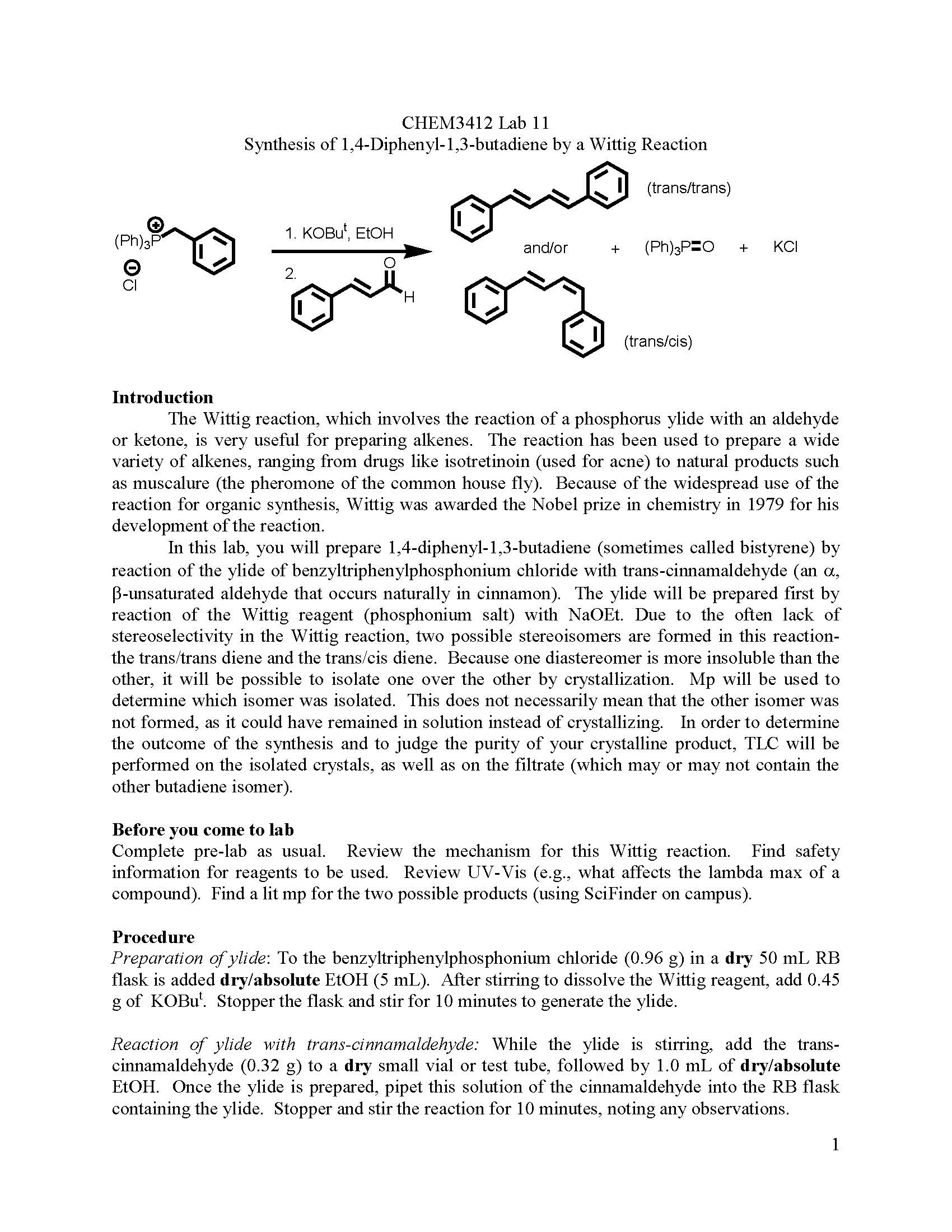
Synthesis of l,4-Diphenyl-l,3-butadiene by a Wittig Reaction \ \ 0 (trans/trans) (PM? 1. KOBut, EtOH 0
9
CI and/or + (Ph)3P:O + KCI —>.
2 O \
. \
w H O \
0 (trans/cis)
Introduction The Wittig reaction, which involves the reaction of a phosphorus ylide with an aldehyde
or ketone, is very useful for preparing alkenes. The reaction has been used to prepare a wide
variety of alkenes, ranging from drugs like isotretinoin (used for acne) to natural products such
as muscalure (the pheromone of the common house fly). Because of the widespread use of the
reaction for organic synthesis, Wittig was awarded the Nobel prize in chemistry in 1979 for his
development of the reaction. In this lab, you will prepare 1,4-diphenyl-1,3-butadiene (sometimes called bistyrene) by
reaction of the ylide of benzyltriphenylphosphonium chloride with trans-cinnamaldehyde (an 0c,
B-unsaturated aldehyde that occurs naturally in cinnamon). The ylide will be prepared first by
reaction of the Wittig reagent (phosphonium salt) with NaOEt. Due to the often lack of
stereoselectivity in the Wittig reaction, two possible stereoisomers are formed in this reaction-
the trans/trans diene and the trans/cis diene. Because one diastereomer is more insoluble than the
other, it will be possible to isolate one over the other by crystallization. Mp will be used to
determine which isomer was isolated. This does not necessarily mean that the other isomer was
not formed, as it could have remained in solution instead of crystallizing. In order to determine
the outcome of the synthesis and to judge the purity of your crystalline product, TLC will be
performed on the isolated crystals, as well as on the filtrate (which may or may not contain the
other butadiene isomer). Before you come to lab Complete pre-lab as usual. Review the mechanism for this Wittig reaction. Find safety
information for reagents to be used. Review UV-Vis (e.g., what affects the lambda max of a
compound). Find a lit mp for the two possible products (using SciFinder on campus). Procedure Preparation ofylide: To the benzyltriphenylphosphonium chloride (0.96 g) in a dry 50 mL RB
flask is added dry/absolute EtOH (5 mL). After stirring to dissolve the Wittig reagent, add 0.45
g of KOBut. Stopper the flask and stir for 10 minutes to generate the ylide. Reaction of ylide with trans-cinnamaldehyde: While the ylide is stirring, add the trans-
cinnamaldehyde (0.32 g) to a dry small vial or test tube, followed by 1.0 mL of dry/absolute
EtOH. Once the ylide is prepared, pipet this solution of the cinnamaldehyde into the RB flask
containing the ylide. Stopper and stir the reaction for 10 minutes, noting any observations.