SuperTutor
$15/per page/Negotiable
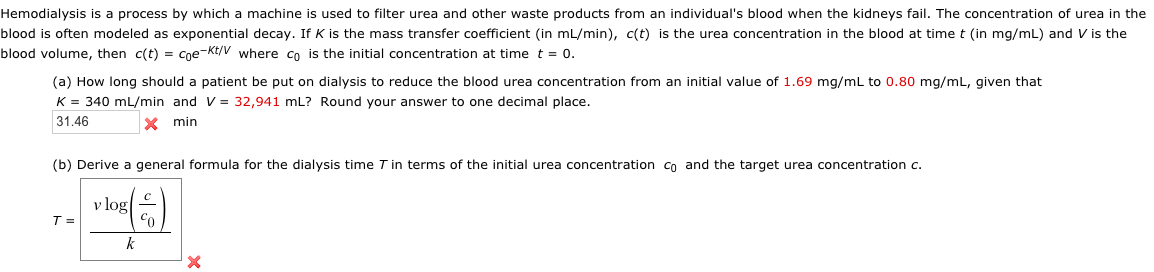
Hemodialysis is a process by which a machine is used to filter urea and other waste products from an individual's blood when the kidneys fail. The concentration of urea in the
blood is often modeled as exponential decay. If K is the mass transfer coefficient (in mUmin), C(t) is the urea concentration in the blood at time t (in mg/mL) and V is the
blood volume, then C(t) = cue—Krill“ where co is the initial concentration at time t = (l. (a) How long should a patient be put on dialysis to reduce the blood urea concentration from an initial value of 1.69 mgme to 0.8!) mg/mL, given that
K = 340 mUmin and V= 32,941 mL? Round your answer to one decimal place.
31.46 x min (b) Derive a general formula for the dialysis time T in terms of the initial urea concentration cu and the target urea concentration c. vlng i
T: ‘n k