SuperTutor
$15/per page/Negotiable
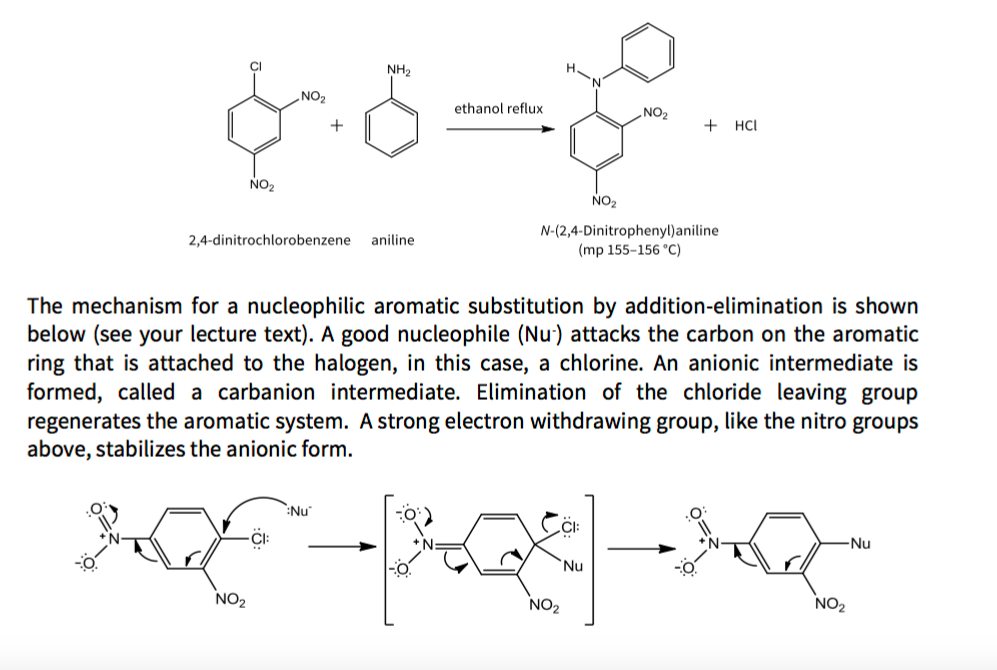
O! NH, H O
‘5‘.
N No;
ethanol reflux N0; + ,, + HCl ~02
no, N-(2.4-Dinitrophenyllaniline
{mp 155-155 °ci 2,4-dinitrochlorobenzene aniline
The mechanism for a nucleophiiic aromatic substitution by addition-elimination is shown
below (see your lecture text). A good nucleophile (Nu-i attacks the carbon on the aromatic
ring that is attached to the halogen, in this case, a chlorine. An anionic intermediate is
formed, called a carbanion intermediate. Elimination of the chloride leaving group regenerates the aromatic system. A strong electron withdrawing group, like the nitro groups
above, stabilizes the anionic form. ,0" L ' -" -. x