ComputerScienceExpert
$18/per page/
The question is attached as a screenshot in the file
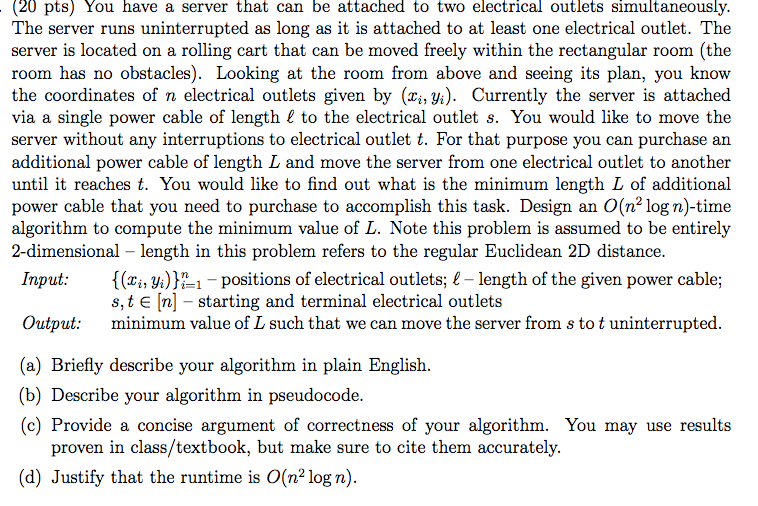
. [20 pts) You have a server that can be attached to two electrical outlets simultaneously.
The server runs uninterrupted as long as it is attached to at least one electrical outlet. The
server is located on a rolling cart that can be moved freely within the rectangular room (the
room has no obstacles). Looking at the room Erom above and seeing its plan, you know
the coordinates of n electrical outlets given by (magi). Currently the server is attached
via a single power cable of length I? to the electrical outlet 3. You would like to move the
server without any interruptions to electrical outlet t. For that purpose you can purchase an
additional power cable of length L and move the server from one electrical outlet to another
until it reaches t. You would like to find out what is the minimum length L of additional
power cable that you need to purchase to accomplish this task. Design an 0(113 log n)-time
algorithm to compute the minimum value of L. Note this problem is assumed to be entirely
2-dimensional — length in this problem refers to the regular Euclidean 2D distance. Input: {(3.}, yg) }?=1 — positions of electrical outlets; E — length of the given power cable;
5, t E [n] — starting and terminal electrical outlets
Output: minimum value of L such that we can move the server from s to t uninterrupted. (a) Briefly describe your algorithm in plain English.
(b) Describe your algorithm in pseudocode. (c) Provide a concise argument of correctness of your algorithm. You may use results
proven in class/textbook, but make sure to cite them accurately. (d) Justify that the runtime is O(n9 log n).