SuperTutor
$15/per page/Negotiable
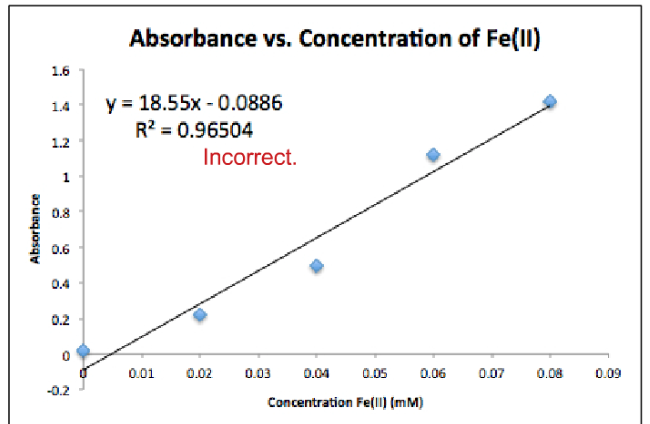
Determination of Fe(III) concentration. The following solutions were prepared:
1. 3.0 mL of Ferric ammonium sulfate dodecahydrate aqueous solution is added to a 25 mL volumetric flask. 40 mg of ferrozine and 1.25 mL of ammonium acetate buffer is added before diluting to volume.
2. 3.0 mL of Ferric ammonium sulfate dodecahydrate aqueous solution is added to a 25 mL volumetric flask. 3.0 mL of hydroxylamine hydrochloride (a reducing agent) was added and the flask was swirled for one minute. 40 mg of ferrozine and 1.25 mL of ammonium acetate buffer is added before diluting to volume.
The absorbance of solution 1 was found to be 0.107 and the absorbance of solution 2 was found to be 0.837. Hint: Ferrozine is a bidentate ligand that binds to Fe (II), not Fe (III). Solution 1 will contain Fe(II) and Fe(III). When the reducing agent is added to solution 2, all Fe(III) is reduced to Fe(II). Any absorbance signal from solution 1 is due to Fe(II) species.
A. What is the concentration of converted Fe(III) -> Fe(II) in solution 2? (Report to 1 sig fig)
B. What is the concentration of Fe(III) in the 3.0 mL of undiluted stock solution of iron ammonium sulfate dodecahydrate aqueous solution? (Report to 1 sig fig)