CourseLover
$10/per page/Negotiable
Question description
Part One
Read the following Review of a Dance Concert
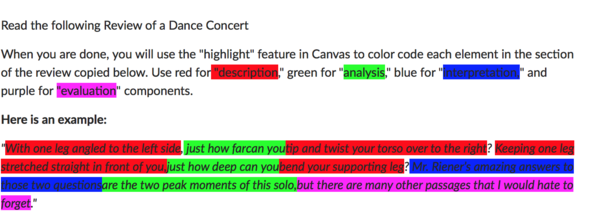
When you are done, you will use the "highlight" feature in Canvas to color code each element in the section of the review copied below. Use red for "description," green for "analysis," blue for "interpretation," and purple for "evaluation" components.
Here is an example:
I ATTACHED THE EXAMPLE IN THE ATTACHMENT FILE
Now your turn:
Copy the text below taken from the review and paste it into your discussion forum post labeled Part one. From there use the "highlight" feature to label the elements of a review as demonstrated above. Use the resource Suggested Guidelines for Dance Criticism to help you.There are usually several components of a review not only in each paragraph, but often in a single sentence, so take your time with this.
"Now he maintains five different fragmented lines throughout parts of his body, then with a change of emphasis resolves them into a single satisfying shape. Now he holds a frozen sculptural position from chest down while bringing a hand down over his face as if wrapping a parcel. At another point he shakes his head rapidly while descending slowly; elsewhere he brings his pelvis powerfully into play; later he folds right over on one leg so that his torso, other leg and arms are all like a tight ball as he perches there.
It’s as if he’s ticking off a list of unimaginable feats one after another — but in fact his rhythm, with phrasing far more subtle than mere clock timing, is more astonishing than his balance. A very few of his inflections are briefly psychological, as if we’re watching flickers of a brainstorm; a few are also animalistic, as if we’re watching him in a cage at the zoo; but mainly he’s a miracle of calm control and supple audacity.
“Split Sides” is a work famous for its use of chance in determining the order of the two musical scores, the two halves of choreography, the two sets of costumes, the two décors at a particular performance. Will the Radiohead music play first or the Sigur Ros? Will the half of the dance with Mr. Riener’s solo occur in black-and-white costumes or colored? Apart from this fun, the choreography contains other strokes of wit (notably in a trio for Jennifer Goggans, Brandon Collwes and John Hinrichs) and a recurrent sense of game playing.
The main subject of the choreography seems to be multi-directionality in space. And it makes time for stillness. Sometimes a tiny detail becomes luminous. At the start of a quintet with four women Rashaun Mitchell stands still at the back of the stage, facing the audience, his legs apart and arms outstretched low to either side. Once you realize that one of his palms is facing up, the other down, it becomes compelling. Not all of “Split Sides” is top-drawer Cunningham, but it’s exciting: watching, we might be in outer space."
Part Two
Return to the clips from the Lesson 2 Discussion Forum and create THREE thesis statements that compare two of the clips, one ANALYTICAL, one INTERPRETIVE and one EVALUATIVE.
1. The first thesis statement should be ANALYTICAL: were there similarities in the choreographers' choices of devices? Did the choreographer/s use the same movement or compositional devices in unique ways from each other?Here are a couple of examples:
"In the two pieces, XXXX and YYYY, the choreographers payed particular attention to his or her use of the stage space to communicate an idea, with XXXX utilizing movement that stayed relatively in one place, and YYYY using movement that traveled the length of the stage space constantly."
"The choreographers for XXXX and YYYY both utilized repetition and canon, although in XXXX the movements were much smoother throughout the entire clip, and in YYYY the choreography alternated between soft waves and hard punches of various parts of the body."
Now it is your turn to write an ANALYTICAL thesis statement comparing two of the clips from the lesson 2 viewings.
2. The second thesis statement should be INTERPRETIVE: what did you think the dances were about? Was there some way the two pieces seemed to be making a similar statement about something? Do the two pieces seem to be making opposing statements about something? Here are a couple of examples:
"When I compared the two pieces XXXX and YYYYY, it became apparent that the choreographers were addressing people's pre-conceived notions of gender and relationships from different viewpoints."
"After carefully examining XXXX and YYYY, I believe the choreographer for the former was communicating how insignificant we are in the universe, and the choreographer for the latter was commenting on how precious each individual life is.
Now it is your turn to write an INTERPRETIVE thesis statement comparing two of the clips from the lesson 2 viewings.
3. The third thesis statement should be EVALUATIVE: did you think the dances were particularly successful at communicating their idea or in their use of choreographic choices? or in their actual performance of the movement? Here are a couple of examples:
"The choreographers in XXXX and YYYY were incredibly successful in communicating the stories in each of the clips through the use of articulate and specific gestures."
"In both XXXX and YYYY, the performers were quite skilled at movement that required them to utilize momentum and maintain a sense of ease in their joints."
Now it is your turn to write an EVALUATIVE thesis statement comparing two of the clips from the lesson 2 viewings.
Attachments: