
SuperTutor

(15)

$15/per page/Negotiable

About SuperTutor

Levels Tought:
Elementary,Middle School,High School,College,University,PHD

Expertise:
Accounting,Business & Finance See all
Accounting,Business & Finance,Economics,Engineering,HR Management,Math Hide all
Teaching Since: Apr 2017
Last Sign in: 335 Weeks Ago, 4 Days Ago
Questions Answered: 12843
Tutorials Posted: 12834

Education

  • MBA, Ph.D in Management
    Harvard university
    Feb-1997 - Aug-2003

Experience

  • Professor
    Strayer University
    Jan-2007 - Present

Category > Management Posted 02 May 2017 My Price 12.00

This Analysis

qusetion:

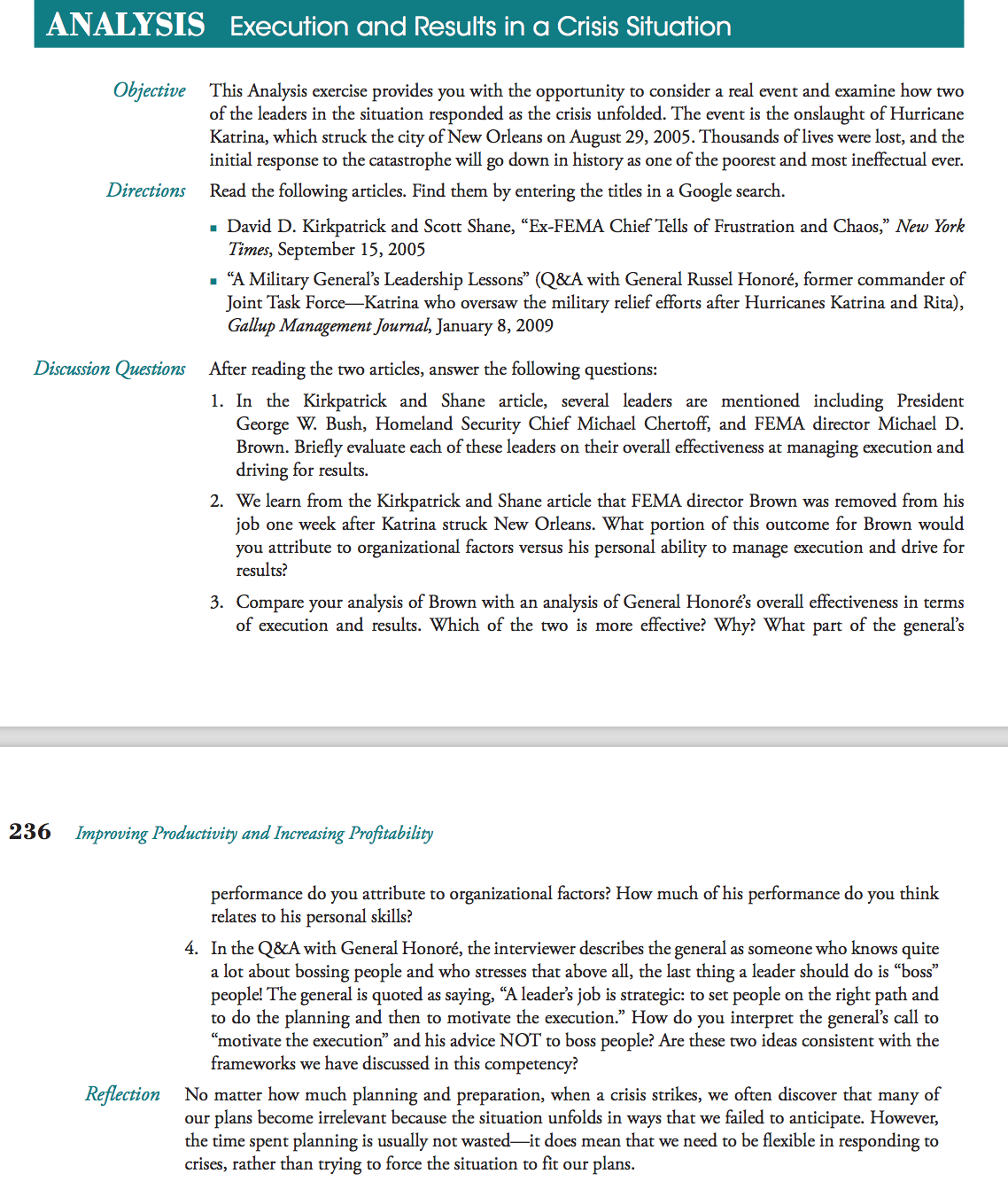
Objective: This Analysis exercise provides you with the opportunity to consider a real event and examine how two of the leaders in the situation responded as the crisis unfolded. The event is the onslaught of Hurricane Katrina, which struck the city of New Orleans on August 29, 2005. Thousands of lives were lost, and the initial response to the catastrophe will go down in history as one of the poorest and most ineffectual ever. 

Directions:Read the following articles. Find them by entering the titles in a Google search.

  • ▪ David D. Kirkpatrick and Scott Shane, “Ex-FEMA Chief Tells of Frustration and Chaos,” New York
  • Times, September 15, 2005
  • ▪ “A Military General’s Leadership Lessons” (Q&A with General Russel Honoré, former commander of Joint Task Force—Katrina who oversaw the military relief efforts after Hurricanes Katrina and Rita), Gallup Management Journal, January 8, 2009 

Discussion Questions:

After reading the two articles, answer the following questions:

  1. In the Kirkpatrick and Shane article, several leaders are mentioned including President George W. Bush, Homeland Security Chief Michael Chertoff, and FEMA director Michael D. Brown. Briefly evaluate each of these leaders on their overall effectiveness at managing execution and driving for results.
  2. We learn from the Kirkpatrick and Shane article that FEMA director Brown was removed from his job one week after Katrina struck New Orleans. What portion of this outcome for Brown would you attribute to organizational factors versus his personal ability to manage execution and drive for results?
  3. Compare your analysis of Brown with an analysis of General Honoré’s overall effectiveness in terms of execution and results. Which of the two is more effective? Why? What part of the general’s performance do you attribute to organizational factors? How much of his performance do you think relates to his personal skills? 
  4. In the Q&A with General Honoré, the interviewer describes the general as someone who knows quite a lot about bossing people and who stresses that above all, the last thing a leader should do is “boss” people! The general is quoted as saying, “A leader’s job is strategic: to set people on the right path and to do the planning and then to motivate the execution.” How do you interpret the general’s call to “motivate the execution” and his advice NOT to boss people? Are these two ideas consistent with the frameworks we have discussed in this competency? 

Reflection 

No matter how much planning and preparation, when a crisis strikes, we often discover that many of our plans become irrelevant because the situation unfolds in ways that we failed to anticipate. However, the time spent planning is usually not wasted—it does mean that we need to be flexible in responding to crises, rather than trying to force the situation to fit our plans. 


8765432345678.png

Attachments:

Answers

(15)
Status NEW Posted 02 May 2017 12:05 AM My Price 12.00

-----------

Attachments

file 1493685900-Solutions file.docx preview (56 words )
S-----------olu-----------tio-----------ns -----------fil-----------e -----------Hel-----------lo -----------Sir-----------/Ma-----------dam----------- T-----------han-----------k y-----------ou -----------for----------- yo-----------ur -----------int-----------ere-----------st -----------and----------- bu-----------yin-----------g m-----------y p-----------ost-----------ed -----------sol-----------uti-----------on.----------- Pl-----------eas-----------e p-----------ing----------- me----------- on----------- ch-----------at -----------I a-----------m o-----------nli-----------ne -----------or -----------inb-----------ox -----------me -----------a m-----------ess-----------age----------- I -----------wil-----------l b-----------e q-----------uic-----------kly----------- on-----------lin-----------e a-----------nd -----------giv-----------e y-----------ou -----------exa-----------ct -----------fil-----------e a-----------nd -----------the----------- sa-----------me -----------fil-----------e i-----------s a-----------lso----------- se-----------nt -----------to -----------you-----------r e-----------mai-----------l t-----------hat----------- is----------- re-----------gis-----------ter-----------ed -----------on-----------th-----------is -----------web-----------sit-----------e. ----------- H-----------YPE-----------RLI-----------NK -----------&qu-----------ot;-----------htt-----------p:/-----------/wo-----------rkb-----------ank-----------247-----------.co-----------m/&-----------quo-----------t; -----------\t -----------&qu-----------ot;-----------_bl-----------ank-----------&qu-----------ot;----------- -----------Tha-----------nk -----------you----------- -----------
Not Rated(0)