SuperTutor
$15/per page/Negotiable
Two paper plants are polluting the bay outside of We with gunk. The authorities have decided that to protect the lobster fisheries, total gunk emissions
must be reduced to '9 tons per day. Plant Ahas marginal emission reduction costs of ‘lfl-xa dollars per day, where g; is the level of pollutio n, and is currently emitting 1D
tons. Plant B has marginal emission reduction costs of iii—Emu dollars per day, where
a; is the level of pollution, and is currently emitting 5 tons. Thus, 15 tons are
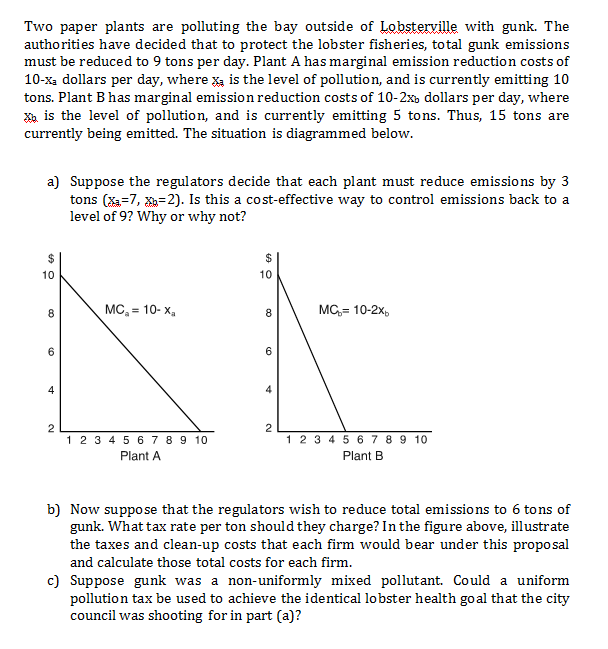
currently being emitted. The situation is diagrammed below. a] Suppose the regulators decide that each plant must reduce emissions by 3 tons [333,21 3352]. Is this a co st-effective way to control emissions back to a
level of 9? ‘Why or why not? 1as455rss1o 123455?391o
Plenth PlantB b] Now suppose that the regulators wish to reduce total emissions to 6 tons of
gunk. ‘What tax rate per ton should they charge? In the figure above, illustrate the taxes and clean-up costs that each firm would bear under this proposal
and calculate those total costs for each firm. c] Suppose gunk was a non-uniformly mixed pollutant. Could a uniform pollutio n tax be used to achieve the identical lobster health go al that the city
council was shooting for in part [a]?