SuperTutor
$15/per page/Negotiable
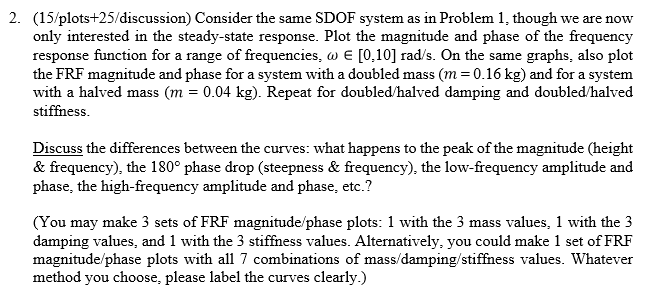
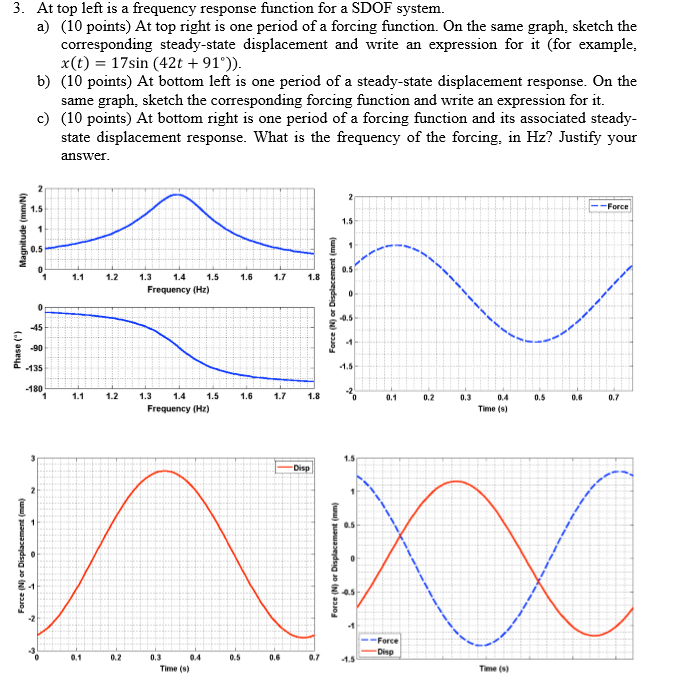
1. {lflfplots+lflfdiscussion) lConsider a SDDF spring—mass—damper with m = fl.fl3 kg, 12' = flfl4
kgfs,an.d k = ENfrn. Attinle E=fl s,ithasinitial conditions x0 =—2 cmand in =—lflfl cmfs.
A force is also applied to the system= ffi} = 3 sinfiut + D“). In class= we derived the
displacement total response {both transient and steady—state) as
sift) = e‘iflmfltljcl sinmdt + :2 cos {out} + fiJIHmJI sin(mt + w + LH[m]}
where
|H[m)| = 4 and slim} = tan-1 2'5”" k -:1 - r21»? +112:an On one graph, plot both the forcing fimnlionflit} and the total response x(t} for Ill = 4 radfs,
fromt=flstot=2fl s_Repeat(ontwon1oregraphs}for£a =5 radfsandm =6 radfs. Discuss how the response differs for each of the three lienquencies — note things like whether
lhe forcing and response are in—fout—of—phase, the relative amplitudfi, the approximate time to
reach steady—state f transient part to dis-ca}.r away, etc. (qualitative descriptions are fine)- Hint: It will may he helpful to derive expressions for C1 and E2 in terms of variables for to, old,
1:“, etc- before plugging in and plotting- To avoid some algebra you might then write a program
u‘{e_g_= hiatlah, Maflsca¢ or even with “Goal Seek" in Excel) to calculate values for E1 and E2.