Effect of a tax on buyers and sellers
7. Effect of a tax on buyers and sellers
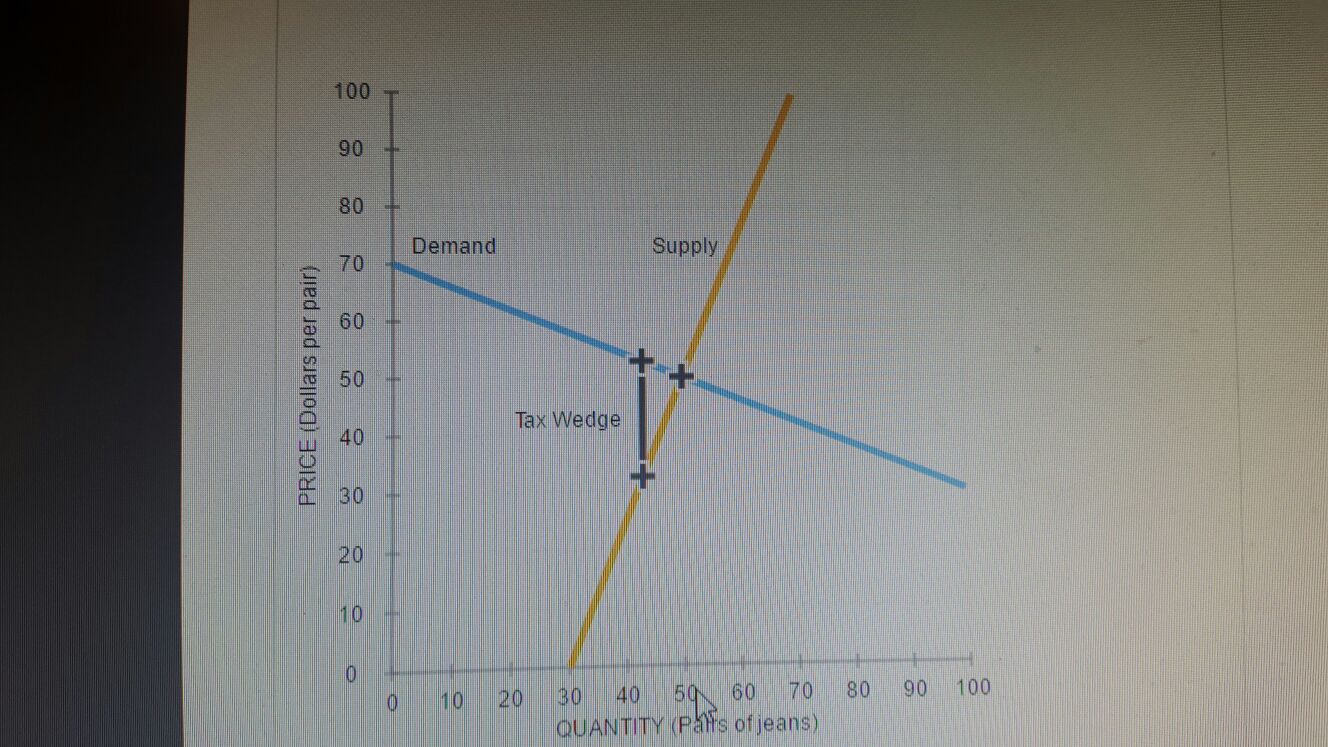
The following graph shows the daily market for jeans. Suppose the government institutes a tax of $20.30 per pair. This places a wedge between the price buyers pay and the price sellers receive.

Fill in the following table with the quantity sold, the price buyers pay, and the price sellers receive before and after the tax.
Quantity Price Buyers Pay Price Sellers Receive
(Pairs of jeans) (Dollars per pair) (Dollars per pair)
Before Tax
After Tax
Using the data you entered in the previous table, calculate the tax burden that falls on buyers and on sellers, respectively, and calculate the price elasticity of demand and supply over the relevant ranges using the midpoint method. Enter your results in the following table.
Tax Burden
(Dollars per pair) Elasticity
Buyers
Sellers
The burden of the tax falls more heavily on the (Less or More) elastic side of the market.
Attachments:
Answers

Status NEW
Posted 03 May 2017 02:05 AM
My Price 7.00
-----------
Attachments
file 1493779795-Solutions file.docx preview (56 words )
S-----------olu-----------tio-----------ns -----------fil-----------e
-----------Hel-----------lo -----------Sir-----------/Ma-----------dam-----------
T-----------han-----------k y-----------ou -----------for----------- yo-----------ur -----------int-----------ere-----------st -----------and----------- bu-----------yin-----------g m-----------y p-----------ost-----------ed -----------sol-----------uti-----------on.----------- Pl-----------eas-----------e p-----------ing----------- me----------- on----------- ch-----------at -----------I a-----------m o-----------nli-----------ne -----------or -----------inb-----------ox -----------me -----------a m-----------ess-----------age----------- I -----------wil-----------l b-----------e q-----------uic-----------kly----------- on-----------lin-----------e a-----------nd -----------giv-----------e y-----------ou -----------exa-----------ct -----------fil-----------e a-----------nd -----------the----------- sa-----------me -----------fil-----------e i-----------s a-----------lso----------- se-----------nt -----------to -----------you-----------r e-----------mai-----------l t-----------hat----------- is----------- re-----------gis-----------ter-----------ed -----------onÂ----------- th-----------is -----------web-----------sit-----------e.
-----------
H-----------YPE-----------RLI-----------NK -----------&qu-----------ot;-----------htt-----------p:/-----------/wo-----------rkb-----------ank-----------247-----------.co-----------m/&-----------quo-----------t; -----------\t -----------&qu-----------ot;-----------_bl-----------ank-----------&qu-----------ot;-----------
-----------Tha-----------nk -----------you-----------
-----------
Not Rated(0)