
The world’s Largest Sharp Brain Virtual Experts Marketplace Just a click Away
Levels Tought:
Elementary,Middle School,High School,College,University,PHD
| Teaching Since: | Jul 2017 |
| Last Sign in: | 304 Weeks Ago, 6 Days Ago |
| Questions Answered: | 15833 |
| Tutorials Posted: | 15827 |
MBA,PHD, Juris Doctor
Strayer,Devery,Harvard University
Mar-1995 - Mar-2002
Manager Planning
WalMart
Mar-2001 - Feb-2009
(a) For the following graph, use a table show all of the steps (table rows) of Dijkstra’s algorithm to find the shortest (minimum cost) paths from node S to all other nodes {A, B, C, D}, where the unidirectional edges are labeled with their costs and path costs are additive.
Â
(b) Repeat part (a) if instead: every edge is labeled with its capacity to carry traffic, the path capacity is the minimum(bottleneck) capacity of its component edges, and the aim of Dijkstra’s algorithm is to find the path from S to D of maximum capacity.
Â
(c) For part (b) suppose the only traffic through the graph is from S to D and all edges may be used. Find the maximum flow F from S to D.
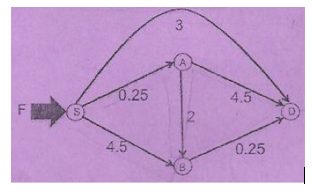
Â
----------- Â ----------- H-----------ell-----------o S-----------ir/-----------Mad-----------am ----------- Th-----------ank----------- yo-----------u f-----------or -----------you-----------r i-----------nte-----------res-----------t a-----------nd -----------buy-----------ing----------- my----------- po-----------ste-----------d s-----------olu-----------tio-----------n. -----------Ple-----------ase----------- pi-----------ng -----------me -----------on -----------cha-----------t I----------- am----------- on-----------lin-----------e o-----------r i-----------nbo-----------x m-----------e a----------- me-----------ssa-----------ge -----------I w-----------ill----------- be----------- qu-----------ick-----------ly