SophiaPretty
$14/per page/Negotiable
Case: Acme Shopping (For R)
You are the data scientist for Acme Shopping, a large shopping mall that incorporates a balanced tenancy of different types of stores along with eating areas. To understand your customers better, you conduct a survey to study beliefs on shopping. You test those beliefs by asking shoppers the six questions listed below. Shoppers then answer using a 7-point Likert scale, from 1 (strongly disagree) to 7 (strongly agree). Your goal is to group the shoppers at Acme Shopping into different segments using Ward’s method. The questions are listed below:
V1. Shopping is fun
V2. Shopping is bad for your budget
V3. I combine shopping with eating out
V4. I try to get the best buys while shopping
V5. I don't care about shopping
V6. You can save a lot of money by comparing prices
You also collect other data, such as income and number of mall visits. Do not include the other data in your analysis.
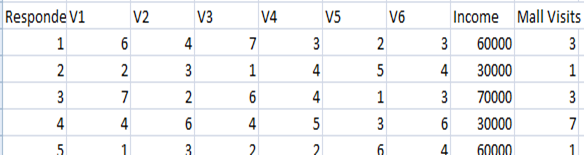
See the associated dataset for the case, “DataScience_8_Case_Shopping.xls”. The screenshot below shows a portion of the data. This case closely follows the dog food example in the lecture.
1. Prepare the data by selecting the subset of the spreadsheet that you need (eliminate any explanatory material in the spreadsheet that is not part of the data). Save the data in comma separated values (CSV) format using the filename “acmeshop”. Read the data into R using the read.csv command. Print out the data in R to ensure it was loaded in correctly. Present the answers in an Adobe PDF or Microsoft Word document, including screenshots of your work in R.
2. Compute the distances between points in the dataset by using the “dist” function. Use the Euclidean method. Next, ask R to compute the hierarchical clusters (hclust), based on the distance matrix you found in the previous step. Present the answers in an Adobe PDF or Microsoft Word document, including screenshots of your work in R.
3. Plot the results of the “hclust” operation into a Dendogram tree diagram. Add boxes around clusters you identified in the Dendogram. Present the answers in an Adobe PDF or Microsoft Word document, including screenshots of your work in R.
4. Commentary: Based on the six questions we asked, what types of segments would you expect to find?
Include research: What types of segments are typically found by market research such as this? (Hint: Google “shopping mall customer segments”)
http://www.emeraldinsight.com/doi/abs/10.1108/09590550710828245
Attachments: